When most people think of an African safari, they imagine lions resting beneath acacia trees, elephants crossing open plains, or giraffes browsing high branches. Yet some of the continent’s most impressive engineers are often overlooked.
Across Africa, a remarkable collection of animals constructs homes, tunnels, nests, and entire communities using skills that rival human architecture in complexity and efficiency. From towering termite mounds that regulate temperature to woven bird nests that withstand harsh weather, these creatures demonstrate that great builders come in all shapes and sizes.
Here are seven of Africa’s natural architects and the incredible structures they create.
Termites: The Master Engineers of the Savannah
Few structures in Africa are as impressive as termite mounds. Rising several meters above the ground, these natural skyscrapers dominate landscapes across the continent.
What makes them remarkable is not just their size but their design. Termites build sophisticated ventilation systems that regulate temperature and humidity inside the colony, even when outside temperatures fluctuate dramatically.

Some mounds house millions of termites working together to maintain a stable environment for the colony. Scientists have even studied termite mound ventilation systems to inspire energy efficient building designs.
For safari travelers, spotting a termite mound is easy. Understanding the engineering behind it is what makes the experience fascinating.
Weaver Birds: Nature’s Skilled Craftsmen
Weaver birds are famous for creating some of the most intricate nests in the animal kingdom.
Using grass, reeds, and plant fibers, males carefully weave hanging nests that can take days to complete. These nests are designed to protect eggs and chicks from predators while remaining secure during strong winds.
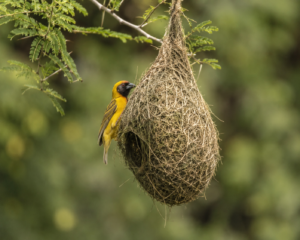
The quality of a nest can even influence a female’s choice of mate. A poorly constructed nest may be rejected, forcing the male to start again from scratch.
Visitors on birdwatching safaris often encounter these remarkable structures hanging from trees or reeds near water bodies.
Social Weavers: Builders of Giant Apartment Complexes
While individual weaver birds build single nests, social weavers take construction to another level.
Found primarily in southern Africa, these birds create massive communal nests that can house hundreds of individuals. Some structures remain occupied for decades and continue expanding over time.
From a distance, these nests resemble large bundles of hay balanced on trees or utility poles. Up close, they reveal a network of chambers and tunnels that provide shelter from both heat and cold.
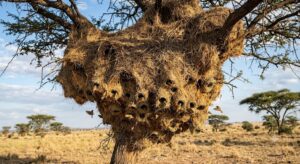
These extraordinary structures have earned social weavers a reputation as some of the most impressive animal builders in Africa.
Honey Bees: Architects of Organized Communities
Honey bees may be small, but their engineering skills are extraordinary.
Within a hive, bees construct perfectly shaped hexagonal honeycombs using wax they produce themselves. This design allows them to maximize storage space while using minimal building material.

Beyond their architectural achievements, bees play a crucial role in pollination, supporting countless plant species across African ecosystems.
Their importance extends beyond the hive. In some regions, beehive fences are used to help reduce human-elephant conflict by discouraging elephants from entering farms. You can learn more about how beehive fences are protecting both people and wildlife in Kenya in our guide, Beehive fences in Kenya.
Naked Mole Rats: Underground City Planners
Hidden beneath the soil, naked mole rats build vast tunnel networks that can stretch for several kilometers.
These underground systems contain specialized chambers for sleeping, food storage, and raising young. The colony operates with a highly organized social structure, with different individuals performing specific roles.
Their tunnel systems protect them from predators and harsh environmental conditions while allowing access to underground food sources.
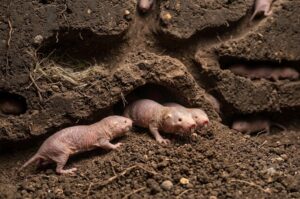
Although visitors rarely see naked mole rats in the wild, their engineering achievements are among the most impressive examples of animal architecture.
Crocodiles: Builders of Protective Nurseries
Nile crocodiles are best known as powerful predators, but they are also careful nest builders.
Female crocodiles construct nests using mud, vegetation, and soil to create a secure environment for their eggs. These nests help regulate temperature and provide protection from predators.

Once the eggs hatch, mothers often assist their young by carrying them to the water, demonstrating that successful architecture in nature often serves a greater purpose than shelter alone.
Along rivers and lakes across Africa, these carefully built nurseries play a crucial role in crocodile survival.
Spiders: Engineers of Precision Traps
Spider webs are among the most elegant structures found in nature.
Built using silk that is both lightweight and incredibly strong, webs are designed to capture prey with remarkable efficiency. Different spider species create different designs, each adapted to its environment and hunting strategy.
Some webs are rebuilt daily, while others are maintained and repaired over time.
Though often overlooked, spiders demonstrate how architecture can serve as both a home and a highly effective hunting tool.
Why Africa’s Natural Architects Matter
The structures built by these animals are more than simple shelters. They help regulate temperature, protect young, store food, attract mates, and ensure survival in challenging environments.
Studying these builders also reveals how interconnected African ecosystems are. Termites influence soil health, bees support pollination, birds disperse seeds, and countless species depend on the habitats these structures create.
For travelers, learning about these hidden architects adds a new dimension to a safari experience. Suddenly, a termite mound becomes more than a pile of soil, and a bird’s nest becomes a masterpiece of natural engineering.
Discover the Hidden Wonders of Africa
Africa’s wildlife is famous for its large mammals, but some of its most fascinating stories are told by much smaller creatures. From towering termite mounds to vast underground tunnel systems, these natural architects showcase the ingenuity and adaptability found throughout the continent.
At Bison safaris, we believe every safari offers an opportunity to look beyond the obvious and appreciate the remarkable details that make African ecosystems so extraordinary. Join us on a journey of discovery and experience the hidden wonders of the wild for yourself. View our safari packages here, to plan your next adventure.