Antelopes in Kenya are among the country’s most fascinating yet often overlooked wildlife species. While the Big Five and the Great Wildebeest Migration attract much of the spotlight, Kenya is home to an incredible diversity of antelopes, each uniquely adapted to different landscapes, from the open savannahs of the Maasai Mara to the forests of the Aberdares and the arid plains of Samburu. These graceful herbivores are often the first animals visitors encounter on safari, yet many travelers struggle to tell one species from another. An impala can easily be mistaken for a gazelle, while a waterbuck may look similar to a reedbuck from a distance.
In reality, Kenya is one of the best places in Africa to observe antelope diversity. From the open plains of the Maasai Mara to the arid scrublands of Samburu and the misty forests of the Aberdares, different species have evolved to thrive in remarkably different environments. Some are among the fastest animals on Earth, while others have developed extraordinary adaptations that allow them to survive in dense forests or semi-desert landscapes.
Learning to identify antelopes transforms a safari experience. Instead of seeing “another deer-like animal,” you’ll begin recognizing the elegant curves of a gerenuk’s neck, the striking facial markings of a beisa oryx, or the distinctive heart-shaped horns of a topi. By the end of this guide, you’ll be able to appreciate the incredible variety of antelopes in Kenya and know exactly where to find many of them.
What Makes an Animal an Antelope?
Despite their similarities to deer, antelopes belong to the Bovidae family, making them close relatives of cattle, buffalo, goats, and sheep. Unlike deer, which shed their antlers every year, antelopes have permanent horns made of a bony core covered by keratin.
Kenya’s antelopes range from species weighing less than 5 kilograms to giants that can exceed 900 kilograms. Some prefer wide-open grasslands where they rely on speed to escape predators, while others remain hidden in forests or rocky hillsides where camouflage is their greatest defense.
Antelopes also play an essential ecological role. By grazing and browsing vegetation, they help maintain healthy ecosystems while serving as an important food source for predators such as lions, leopards, cheetahs, African wild dogs, and hyenas.
How Many Species of Antelope Live in Kenya?
Kenya is home to around 25 to 30 antelope species, depending on how certain species and subspecies are classified. This remarkable diversity makes the country one of Africa’s premier destinations for wildlife enthusiasts and photographers.
Some species, such as impalas and Thomson’s gazelles, are abundant and easy to spot. Others, including the critically endangered hirola and elusive mountain bongo, are among Africa’s rarest mammals.
The Most Common Antelopes in Kenya
Impala
Perhaps the most familiar antelopes in Kenya, the impala is known for its reddish-brown coat, elegant lyre-shaped horns in males, and incredible jumping ability. A startled impala can leap more than 10 meters in a single bound while clearing heights of up to 3 meters.
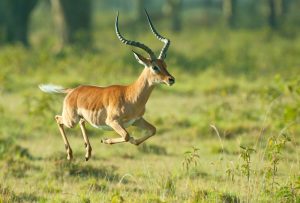
Where to see: Maasai Mara, Amboseli, Tsavo, Lake Nakuru, Meru, Nairobi National Park.
Interesting fact: Impalas often mix with zebras and wildebeest because different species help detect predators more effectively.
Thomson’s Gazelle
Often called “Tommies,” these small gazelles are among the fastest animals in Africa. Their white belly, bold black side stripe, and constantly twitching tail make them easy to recognize.
Where to see: Maasai Mara, Amboseli, Nairobi National Park.
Interesting fact: They can reach speeds of around 80 km/h while performing spectacular zigzag escapes from cheetahs.
Grant’s Gazelle
Larger than Thomson’s gazelle, Grant’s gazelle has a whiter rump and lacks the prominent black stripe extending across the hindquarters.
Where to see: Amboseli, Samburu, Maasai Mara, Tsavo.
Interesting fact: Grant’s gazelles can survive for long periods without drinking water, obtaining most of their moisture from plants.
Common Waterbuck
This shaggy antelope prefers areas close to rivers, lakes, and wetlands. Males carry long, ridged horns that sweep backward and forward.
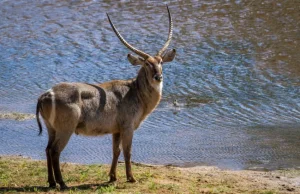
Where to see: Lake Naivasha, Amboseli, Maasai Mara, Meru, Tsavo.
Interesting fact: Their oily coat gives off a strong scent that may make predators less interested in eating them.
Defassa Waterbuck
Closely related to the common waterbuck, the Defassa waterbuck is distinguished by its solid white rump rather than the white ring seen on the common species.
Where to see: Western Kenya and parts of the Rift Valley.
Interesting fact: Although similar in appearance, the two waterbuck species rarely overlap extensively.
Topi
The topi stands out with its glossy reddish-brown body and striking bluish-black patches on its upper legs and face. It often stands on termite mounds to scan for danger.
Where to see: Maasai Mara.
Interesting fact: Topis are among the fastest antelopes and can maintain high speeds over long distances.
Coke’s Hartebeest (Kongoni)
This large antelope has an elongated face and uniquely shaped horns that resemble a sideways “S.”
Where to see: Nairobi National Park, Maasai Mara, Tsavo.
Interesting fact: Despite its unusual appearance, it is one of Africa’s most efficient long-distance runners.
Common Eland
Africa’s largest antelope is surprisingly gentle. Mature bulls can weigh nearly one ton yet move with remarkable grace.
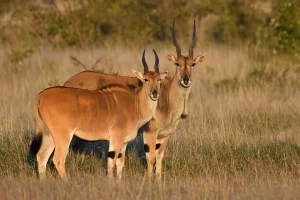
Where to see: Maasai Mara, Amboseli, Tsavo, Laikipia.
Interesting fact: Elands can jump fences over 2 meters high despite their enormous size.
Bushbuck
A shy forest antelope with beautiful white spots and stripes, the bushbuck is usually seen alone or in pairs.
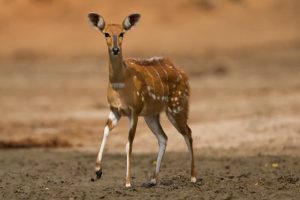
Where to see: Aberdare, Mount Kenya, Kakamega Forest, Meru.
Interesting fact: Unlike many antelope species, bushbucks are mostly active during the early morning and evening.
Bohor Reedbuck
This medium-sized antelope favors wetlands and tall grass, where it often freezes instead of running when threatened.
Where to see: Maasai Mara, Lake Nakuru, Mwea National Reserve.
Interesting fact: When finally disturbed, it gives a distinctive whistling alarm call.
Oribi
The oribi is a small, slender antelope with a reddish coat and large ears.
Where to see: Maasai Mara and western Kenya.
Interesting fact: Males defend territories using scent glands located below their eyes.
Suni
Among Kenya’s smallest antelopes, the suni inhabits dense coastal forests where it remains well hidden.
Where to see: Arabuko Sokoke Forest and coastal forests.
Interesting fact: Adults often weigh less than 15 kilograms.
Kirk’s Dik-dik
Tiny, delicate, and unmistakably adorable, the dik-dik is one of Kenya’s most beloved antelopes. It has an elongated snout that helps cool its blood in hot climates.
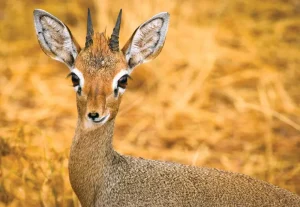
Where to see: Samburu, Tsavo, Amboseli, Meru.
Interesting fact: Dik-diks usually mate for life and maintain small territories together.
Klipspringer
Built for life among rocky cliffs, the klipspringer walks almost on the tips of its hooves for exceptional balance.
Where to see: Hell’s Gate, Samburu, rocky escarpments.
Interesting fact: Pairs often remain together for many years.
Gerenuk
Known as the “giraffe gazelle,” the gerenuk has an extraordinarily long neck and frequently stands upright on its hind legs to browse shrubs.
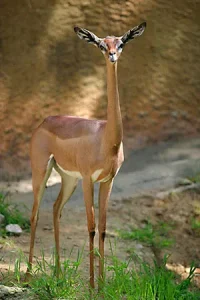
Where to see: Samburu, Buffalo Springs, Shaba, northern Kenya.
Interesting fact: Few other antelopes can feed at heights that gerenuks easily reach.
Beisa Oryx
With its straight spear-like horns and bold black-and-white facial markings, the beisa oryx is perfectly adapted to Kenya’s dry northern landscapes.
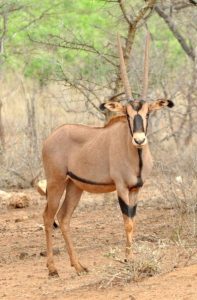
Where to see: Samburu, Buffalo Springs, Shaba, Laikipia.
Interesting fact: It can tolerate extremely high body temperatures, helping it conserve water.
Fringe-eared Oryx
Closely related to the beisa oryx, this species is recognized by the long tufts of hair on its ears.
Where to see: Tsavo East, Amboseli.
Interesting fact: It is one of the characteristic antelopes of Kenya’s southern drylands.
Lesser Kudu
This elegant antelope has narrow white stripes across its body and impressive spiral horns on males.
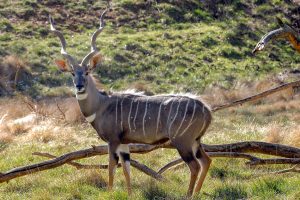
Where to see: Samburu, Tsavo East, Meru.
Interesting fact: It relies on camouflage rather than speed to avoid predators.
Greater Kudu
Although much rarer in Kenya than elsewhere in southern Africa, the greater kudu occasionally occurs in suitable habitats.
Where to see: Isolated areas of northern Kenya.
Interesting fact: Its spectacular spiral horns can exceed 1.5 meters in length.
Mountain Bongo
One of Africa’s most beautiful antelopes, the mountain bongo is instantly recognizable by its chestnut coat and striking white vertical stripes.
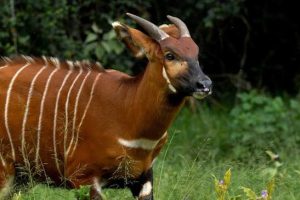
Where to see: Conservancy breeding programs and protected forests around the Aberdares and Mount Kenya.
Interesting fact: It is one of Kenya’s most endangered mammals, with intensive conservation efforts underway to restore wild populations.
Blue Duiker
A tiny forest antelope with a bluish-gray coat.
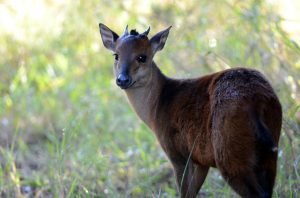
Where to see: Kakamega Forest and coastal forests.
Interesting fact: It feeds on fruits that fall from the forest canopy.
Yellow-backed Duiker
The largest of Africa’s duikers, it inhabits dense forests where sightings are uncommon.
Where to see: Kakamega Forest.
Interesting fact: Despite being an antelope, it may occasionally eat insects and other small animal matter.
Bush Duiker
Secretive and mostly nocturnal, bush duikers inhabit thick vegetation throughout parts of Kenya.
Where to see: Forests and dense bushlands.
Interesting fact: They are often detected only by the rustling of vegetation as they disappear into cover.
Hirola
Among the rarest antelopes in the world, the hirola is found naturally only in northeastern Kenya today. Its distinctive white “spectacles” around the eyes make it easy to identify.
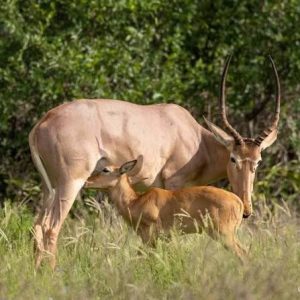
Where to see: Ishaqbini Hirola Conservancy and surrounding areas.
Interesting fact: Fewer than a thousand remain in the wild, making every sighting exceptionally special.
Where to See Different Antelope Species in Kenya
| Destination | Notable Species |
|---|---|
| Maasai Mara | Impala, Topi, Thomson’s Gazelle, Eland |
| Samburu | Gerenuk, Beisa Oryx, Lesser Kudu, Dik-dik |
| Amboseli | Grant’s Gazelle, Fringe-eared Oryx, Eland |
| Tsavo East | Fringe-eared Oryx, Lesser Kudu, Dik-dik |
| Meru | Lesser Kudu, Waterbuck, Bushbuck |
| Aberdare | Mountain Bongo, Bushbuck |
| Kakamega Forest | Blue Duiker, Yellow-backed Duiker |
| Nairobi National Park | Impala, Coke’s Hartebeest, Thomson’s Gazelle |
How to Tell Similar Antelopes Apart
Many first-time safari visitors confuse similar-looking species, but a few key features make identification easier.
Thomson’s gazelles are smaller and have a bold black stripe along their sides, while Grant’s gazelles are larger with a noticeably whiter rump. Waterbucks are stockier and almost always stay near water, whereas reedbucks are smaller and favor tall grass. Oryx species carry long, straight horns and thrive in dry country, while kudus are identified by their spiral horns and beautifully striped coats. Topis have dark blue-black patches on their upper legs, whereas hartebeests have elongated faces and uniquely shaped horns.
The more time you spend observing these details, the easier it becomes to identify antelopes at a glance.
Why Kenya Is One of the Best Places in Africa to See Antelopes
Few countries can match Kenya’s diversity of habitats, from alpine forests and mountain slopes to savannahs, wetlands, deserts, and coastal woodlands. This variety allows an impressive range of antelope species to flourish, each adapted to a specific environment.
Kenya’s extensive network of national parks, reserves, and community conservancies also provides excellent opportunities to observe both common and rare species in their natural habitats. Whether you’re watching impalas grazing beneath acacia trees in the Maasai Mara, spotting a gerenuk browsing upright in Samburu, or hoping for a glimpse of the elusive mountain bongo in the Aberdares, every safari offers a chance to appreciate the remarkable diversity of these often-overlooked animals.
The Big Five may be the stars of most safari itineraries, but Kenya’s antelopes tell an equally fascinating story. Their extraordinary adaptations, varied habitats, and remarkable diversity reveal just how complex and interconnected Kenya’s ecosystems truly are. Learning to identify them adds a new layer of excitement to every game drive, turning ordinary sightings into memorable wildlife encounters.
Whether you’re planning your first safari or returning to discover more of Kenya’s incredible biodiversity, taking the time to appreciate its antelopes will enrich your experience in ways you might never have expected. At Bison Safaris, our experienced guides help guests recognize not just the famous animals, but also the remarkable antelope species that make Kenya one of Africa’s greatest wildlife destinations. Contact us today to plan your next adventure.