Far from Ethiopia’s historic cities and well known highland landscapes lies a very different side of the country. In the remote southwestern part of Ethiopia, the Omo River winds through dry grasslands, forests and rugged terrain, supporting communities whose lives have been closely connected to the land for generations.
Among them are the Mursi, one of the best-known communities of the Lower Omo Valley.
The Mursi are internationally recognized for their distinctive body decoration, particularly the clay and wooden lip plates traditionally worn by some women. Their ceremonial stick fighting, cattle culture, body painting and traditional way of life have also attracted considerable attention from travellers and photographers.
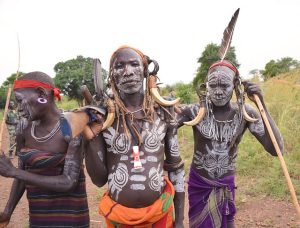
Yet there is much more to the Mursi community than the images most commonly associated with them.
They are an agro-pastoralist society with a rich oral tradition, strong relationships with cattle and a way of life shaped by the seasonal rhythms of the Omo River. At the same time, their society is changing as environmental pressures, development, markets and tourism increasingly influence life in the Omo Valley.
Understanding the Mursi therefore means looking beyond the famous photographs and discovering the people, landscape and traditions behind them.
Where Do the Mursi Live?
The Mursi live in southwestern Ethiopia, primarily in the Lower Omo Valley between the Omo and Mago rivers. The region is one of the most culturally diverse parts of the country, with numerous communities living across a relatively remote landscape.
The Mursi’s environment is demanding. Much of the region is hot and relatively dry, and communities have traditionally had to adapt their livelihoods to changing water availability, rainfall and grazing conditions.
The Omo River is particularly important. During the dry season, many Mursi move closer to the river and cultivate land along its banks. When the rains arrive, they can move towards the grasslands where their cattle find better grazing.
For this reason, describing the Mursi simply as nomadic does not give an accurate picture of their lifestyle. They have traditionally combined cultivation with cattle keeping and seasonal movement rather than constantly wandering from one place to another.
Their lives have therefore always been closely connected to the landscape around them.
A Life Shaped by the Omo River
The Omo River is one of the defining geographical features of southwestern Ethiopia. It flows southwards before eventually reaching Lake Turkana, and its seasonal patterns have historically been important to communities living along its banks.
For the Mursi, farming has traditionally included cultivation of crops such as sorghum and maize. Riverbank agriculture has been particularly important because seasonal changes in water levels can leave behind fertile soil suitable for cultivation.
Agriculture, however, is only one part of the picture.
Cattle are central to Mursi life. They provide milk and blood as important sources of food and can also provide meat. But their importance goes far beyond what they provide as livestock.
Cattle are connected to marriage, social relationships, ceremonies and ideas of identity. They can serve as bride-wealth and are involved in important social and ritual exchanges. Research on Mursi society describes cattle as playing such a central role that they help connect family relationships, age groups and the wider social order.
This is why a herd of cattle should not be viewed simply as an economic asset when looking at Mursi culture. Cattle are part of the social fabric of the community.
The Importance of Cattle in Mursi Culture
Across many pastoral and agro-pastoral societies of eastern Africa, cattle have traditionally represented far more than wealth, and the Mursi are no exception.
A person’s relationship with cattle can be connected to family, marriage and social standing. Cattle also appear in Mursi ideas about colour, landscape and identity.
The Mursi have traditionally developed detailed knowledge of their animals, including their appearance and characteristics. Cattle can be named and described in ways that reflect their colours and markings, and landscapes themselves can be given names inspired by cattle.
This close relationship between people and livestock is one of the reasons the Mursi way of life is so closely associated with pastoralism, even though cultivation remains an important part of their subsistence.
The result is a culture in which the environment, agriculture, cattle and human relationships are deeply interconnected.
Mursi Villages and Everyday Life
Traditional Mursi settlements are adapted to the hot and sometimes harsh environment of the Omo Valley.
Homes are generally simple structures made using locally available materials such as branches, grass and reeds. Their relatively temporary and portable nature reflects a lifestyle in which people may move between different areas depending on the season and the needs of their livestock and crops.
But everyday life in a Mursi settlement is not simply about survival.
The Mursi have a strong oral tradition through which history, knowledge, philosophical ideas and moral lessons are passed from one generation to another. Conversation, music, storytelling and social gatherings are important parts of community life.
This is something that is easy to overlook when the Mursi are presented only through photographs of their most distinctive traditions.
Like any other society, their culture exists in ordinary moments as much as in ceremonies: people working, talking, caring for children, tending cattle, preparing food and spending time together.
The Famous Mursi Lip Plates
Few cultural traditions have made a community as instantly recognizable as the lip plates of the Mursi.
The plates, known locally as dhebi a tugoin, are large wooden or pottery discs traditionally worn in the lower lips of some Mursi women.
The practice generally begins during adolescence. According to Mursi-focused research, a girl’s lower lip may be pierced around the age of 15 or 16, after which a small wooden plug is inserted. As the wound heals, progressively larger plugs can be introduced, gradually stretching the lip.
Some women eventually wear large circular plates, while others do not stretch their lips to the same extent. Not every Mursi woman wears a large plate.
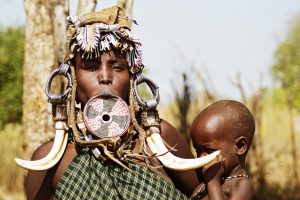
This is important because popular travel stories often portray the practice as something imposed on every Mursi girl.
In reality, the tradition is more complicated and has cultural meanings relating to identity, social maturity, morality, beauty and fertility.
The size of a plate can also vary considerably. Some women choose to stretch their lips enough to accommodate plates measuring more than 10 centimeters across, while others choose smaller plates or do not continue the process.
Why Do Mursi Women Wear Lip Plates?
Perhaps the most famous explanation repeated in travel writing is that Mursi women historically wore lip plates to make themselves unattractive to slave traders.
It is an appealing story because it seems to provide a simple explanation for an unusual tradition.
However, Mursi-focused anthropological research does not support the slave-raiding explanation as the origin of the practice.
Instead, lip plates are understood within Mursi society as part of a much broader system of body decoration and social identity. They have traditionally been associated with maturity, fertility, marriageability and ideas about what it means to become a socially responsible woman.
For Mursi people themselves, the lip plate can therefore communicate meanings that are invisible to an outsider.
This is an important distinction when visiting communities such as the Mursi. A cultural practice does not become meaningless simply because visitors do not immediately understand it.
Body Painting and Mursi Beauty
Lip plates are only one part of Mursi body decoration.
Both men and women have traditions of body painting, scarification, hairstyles and ornamentation. White body paint is particularly recognizable in photographs of Mursi people, although traditional decoration has many forms.
Body decoration can express identity, beauty and social meaning, and different styles may be associated with different occasions.
However, travellers should also be aware that tourism has influenced the way some Mursi people present themselves to visitors.
Mursi-focused research notes that some forms of elaborate decoration may now be deliberately created when tourists arrive because photographs can provide an opportunity to earn money. This means that a photograph taken during a tourist visit does not necessarily show what a person looks like during an ordinary day.
That does not make the decoration “fake.” Rather, it demonstrates how tourism has become part of the cultural encounter itself.
Donga: The Mursi Stick-Fighting Tradition
Another tradition strongly associated with the Mursi is donga, the ceremonial stick fighting practiced by young men.
Participants use long wooden poles in controlled bouts that demonstrate physical ability, courage and skill.
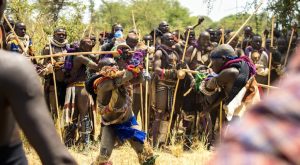
To someone unfamiliar with Mursi culture, donga can initially appear to be simply a violent competition. But within Mursi society, it has much deeper social significance.
The tradition is connected to age groups, identity and relationships between communities. It can bring people together and provide young men with an opportunity to demonstrate qualities that are valued within their society.
Donga is therefore not simply about defeating another person. It forms part of a wider social system involving age, status, relationships and community life.
The practice also illustrates an important point about traditional societies: ceremonies that appear unusual to outsiders often have their own rules and meanings that cannot be understood simply by observing them from the outside.
Age and Community Organization
Mursi society has traditionally placed considerable importance on age and social relationships.
Different stages of life come with different responsibilities and expectations. Young men, for example, move through age-based stages that shape their roles within the community.
This system helps organize relationships between people and provides a framework through which knowledge and responsibilities are passed between generations.
Elders also have important roles within the community, particularly in matters involving social relationships, disputes and collective decisions.
This does not mean that every aspect of Mursi society can be reduced to a simple hierarchy. The Mursi have often been described by researchers as relatively egalitarian in important respects, with social organization based on age, relationships and community institutions rather than a highly centralized political structure.
Their social world is therefore complex, and it cannot be accurately described using a simple image of “tribal chiefs” and followers.
Food and Survival in the Omo Valley
Food traditions are closely connected to the Mursi’s environment and livelihoods.
Cattle provide milk and blood, while agriculture provides crops such as sorghum and maize. The combination of livestock keeping and cultivation gives the community several sources of food in a landscape where environmental conditions can be unpredictable.
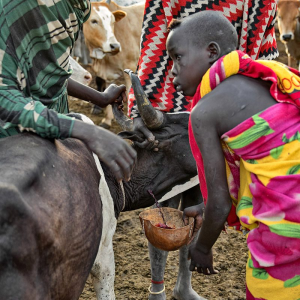
Sorghum is particularly valuable because it is well suited to relatively dry conditions and can be used in different ways.
The Mursi’s ability to combine agriculture with cattle keeping is an example of how communities adapt their livelihoods to challenging environments.
Rather than depending entirely on one resource, they have traditionally developed a system that makes use of both the river and the surrounding grasslands.
A Culture Rich in Stories and Knowledge
One of the less visible aspects of Mursi culture is its oral tradition.
Before written records became part of everyday life, knowledge was passed from one generation to another through speech, stories, songs and conversations.
These traditions preserve information about history, relationships, morality and the environment.
Storytelling also gives younger generations a way of learning how their society understands right and wrong, responsibility and relationships.
For travellers, this side of Mursi culture may be less immediately visible than lip plates or body painting, but it is arguably just as important.
A culture is not defined only by what can be photographed.
It is also found in the stories people tell, the knowledge they pass down and the way they understand their place in the world.
The Mursi and a Changing Environment
The traditional Mursi way of life has always depended heavily on the environment, which makes environmental changes particularly significant.
One major change came with the construction of the Gibe III Dam upstream on the Omo River. The dam was completed in 2016 and significantly altered the river’s natural seasonal flooding.
This matters because traditional flood-retreat cultivation along the Omo depended on the river’s natural cycle.
Changes to water availability and agricultural patterns can therefore have consequences for food production and the wider way communities use the landscape.
The Mursi are also affected by broader pressures such as population growth, access to markets, government development programmes and changing economic opportunities.
The image of the Mursi as a community completely isolated from the modern world is therefore misleading.
They are living through change just like communities elsewhere.
Tourism and the Mursi
Tourism has brought the Mursi considerable international attention.
Travellers visiting Ethiopia’s Omo Valley often hope to meet Mursi communities and see traditions that have become famous around the world.
This can provide opportunities for local people to earn money and interact with visitors, but it has also created tensions.
The Mursi are among the most photographed people in Ethiopia. In some situations, visitors may arrive primarily interested in taking photographs rather than learning about the people they are meeting.
This has contributed to an uncomfortable relationship between tourism and cultural identity.
A traveller may see a woman wearing a lip plate and immediately think of a photograph. The woman herself, however, is not a tourist attraction. She is a person going about her life within her own community.
That distinction is essential.
How to Visit the Mursi Respectfully
Anyone visiting the Mursi should approach the experience as a cultural encounter rather than a wildlife-style viewing experience.
Photography should be handled respectfully, with visitors following local guidance and asking permission where appropriate.
It is also important not to assume that every person wants to be photographed simply because they are wearing traditional clothing or body decoration.
Travellers should listen to their local guides, respect community rules and remember that the Omo Valley is people’s home.
The best cultural experiences are not necessarily the ones that produce the most photographs. They are the ones that leave visitors with a better understanding of the people and place they have encountered.
The Omo Valley’s Extraordinary History
The Mursi story is also part of a much larger story about humanity itself.
The Lower Omo Valley is one of the world’s most important regions for understanding human evolution. It contains fossil and archaeological evidence dating back millions of years, including discoveries that have contributed significantly to scientific understanding of early human development.
UNESCO designated the Lower Valley of the Omo a World Heritage Site in 1980 because of its outstanding paleontological and archaeological importance. You can also read about other sites in our guide to The Best UNESCO World Heritage Sites in Africa.
The region’s significance is therefore extraordinary. It is a place where scientists study evidence of humanity’s deep past while living communities continue their lives in the same broad landscape today.
The combination of ancient human history and living cultural traditions makes the Omo Valley one of Ethiopia’s most fascinating regions.
More Than the Lip Plates
The Mursi community is often introduced to the world through one image: a woman wearing a large clay plate in her lower lip.
But reducing an entire society to that image misses the bigger story.
The Mursi are farmers and cattle keepers. They are storytellers and craftspeople. They have age-based social systems, ceremonies, music, body art and traditions that have developed over generations.
Their relationship with cattle reflects a complex understanding of wealth, identity and social relationships. Their connection to the Omo River demonstrates how closely culture can be tied to the environment. Their body decoration carries meanings that cannot always be understood through a photograph.
And their relationship with tourism shows that even communities often described as “traditional” are constantly adapting to a changing world.
The Mursi are not a window into some frozen version of Africa’s past.
They are a living community with a culture that continues to evolve.
For travellers who venture into the Omo Valley, that is perhaps the most important lesson of all. The real value of meeting the Mursi is not simply seeing a famous tradition with your own eyes. It is having the opportunity to understand the people behind the images, the landscape that shaped their way of life and the traditions that continue to give their community its identity.
The Omo Valley reminds us that Africa’s cultural richness cannot be captured in a single photograph. Sometimes, the most meaningful part of a journey begins when we look beyond the image and take the time to understand the story.