There are forests where you can follow a trail beneath towering trees, forests where sunlight filters through a leafy canopy, and forests where the calls of birds echo across the land. Then there is the Sundarbans mangrove forest, a place where the idea of a forest seems to change completely.
Here, water is as important as land. Rivers and tidal creeks wind between hundreds of islands, while mudflats appear and disappear with the movement of the tide. Trees grow from waterlogged ground, their roots reaching into salty mud. There are few conventional roads deep inside the wilderness, and much of the forest is best explored from the water.
Somewhere among those tangled mangroves lives one of the world’s most remarkable tiger populations.
The Bengal tiger of the Sundarbans has learned to survive in a landscape that would be extraordinarily difficult for most large predators. It swims across tidal channels, moves through thick vegetation and hunts in an environment where the boundary between land and water is constantly changing. Yet the tiger is only one part of the story.
The Sundarbans mangrove forest is a vast living system shared by India and Bangladesh. It is shaped by three great rivers, influenced by the Bay of Bengal and home to an extraordinary variety of terrestrial, freshwater and marine life. UNESCO recognizes the Sundarbans as a World Heritage site because of both its exceptional biodiversity and the continuing natural processes that shape its landscape. You can also view our guide to The Best UNESCO World Heritage Sites in Africa, 20 Interesting Places Worth Visiting.
It is also a place where nature and human life are inseparable.
Communities around the forest depend on its waters and natural resources, while the mangroves themselves provide a natural buffer against storms, tidal surges and coastal erosion. At the same time, climate change, changing salinity, erosion, pollution and pressure on natural resources are creating difficult challenges for the future.
To understand why this forest matters, you have to look beyond the image of the tiger. The real story of the Sundarbans begins with the water.
Where the Sundarbans Mangrove Forest Meets the Sea
The Sundarbans occupies the enormous delta created by the Ganges, Brahmaputra and Meghna river systems before they reach the Bay of Bengal. These rivers carry enormous quantities of water and sediment toward the coast, helping create a landscape that is constantly being reshaped by tides, floods and erosion.
That makes the Sundarbans unlike a conventional forest destination.
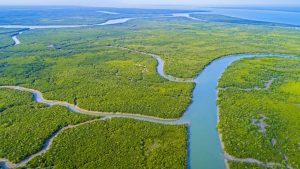
There is no single solid block of woodland stretching uninterrupted from one horizon to another. Instead, the ecosystem is a mosaic of islands, channels, creeks, mudflats, wetlands and mangrove vegetation. Water cuts through the landscape in countless directions, sometimes narrowing into quiet channels and at other times opening into broad expanses connected to the estuary.
The wider Sundarbans stretches across the international boundary between India and Bangladesh. UNESCO describes the Bangladeshi World Heritage property as part of a much larger transboundary ecosystem, with the Indian Sundarbans World Heritage site lying immediately beyond the border. Together, these areas form one of the most important mangrove landscapes on Earth.
The numbers alone are impressive. UNESCO describes the broader Sundarbans as covering around 10,000 square kilometers of land and water, while the Bangladesh portion contains the world’s largest contiguous mangrove forest. But its importance cannot really be understood through size alone.
The remarkable thing is that such a vast ecosystem exists in a place where land is constantly being created, eroded and rearranged.
A sandbank or muddy island can change shape. A river channel can widen or shift. Tidal water can cover an area that was exposed only hours earlier. The forest has developed within this instability rather than trying to escape it.
In a sense, the Sundarbans does not simply occupy the delta. It is part of the process that is still creating the delta.
A Forest Built for Saltwater
Mangrove forests are among nature’s great specialists.
Most trees would struggle to survive in soil regularly flooded by salty or brackish water. Mangroves have evolved a remarkable collection of adaptations that allow them to grow where freshwater plants would quickly fail. Their roots, leaves and other structures are designed for a world in which tides regularly change the conditions around them.
Walking or travelling through the Sundarbans mangrove forest, it is easy to notice how different the vegetation looks from an inland forest. Trees appear to emerge directly from mud and shallow water, while exposed roots create complicated structures along the edges of channels.
Those roots are much more than a means of keeping the trees upright.
They slow the movement of water, trap sediment and create shelter for small aquatic organisms. Fish, crabs, mollusks and other creatures can find food and protection among the roots and muddy channels. As vegetation grows and sediment accumulates, the mangrove itself becomes part of the process that shapes the coastline.
This is one reason mangroves are so valuable. They are simultaneously forest, wetland and coastal habitat.
The Sundarbans is particularly remarkable because the mangrove ecosystem is exceptionally diverse. UNESCO records hundreds of plant and animal species across the Bangladeshi World Heritage property, including a remarkable range of mammals, reptiles, fish, birds and aquatic organisms.
The forest may appear quiet when viewed from a boat, but beneath that quiet surface is a remarkably productive ecosystem.
Why the Tide Is So Important
The tide is one of the forces that gives the Sundarbans its character.
In many forests, the landscape changes mainly with the seasons. In the Sundarbans, the landscape can change within a single day. Water moves through the channels, flooding some areas and exposing others. Sediment is transported from one location to another, while the roots of mangroves help trap some of that material.
Over long periods, these processes contribute to the formation and transformation of islands and shorelines.
This is one of the reasons UNESCO considers the Sundarbans an outstanding example of continuing ecological processes. Monsoon rainfall, river flooding, tidal influence, sediment deposition and plant colonization all interact to shape the ecosystem.
The result is a landscape that is never completely finished. Even the ground beneath the forest is part of an ongoing story.
That constant movement also explains why the Sundarbans can feel both beautiful and slightly mysterious. A channel that appears familiar from one visit may look different later. Mudflats emerge from the water, vegetation takes hold, and erosion removes pieces of land elsewhere.
The forest is alive not only because of its wildlife, but because the physical landscape itself is continually changing.
The Bengal Tiger That Learned to Live With Water
Few animals are as closely associated with the Sundarbans mangrove forest as the Bengal tiger.
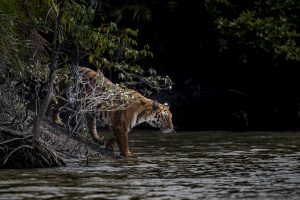
Tigers are often imagined moving silently through dry forests or open grasslands, but the Sundarbans population has adapted to a very different environment. These tigers live among tidal waterways, muddy ground and dense mangrove vegetation, and they are notably capable swimmers.
That ability is more than an interesting curiosity.
Water is unavoidable here. A tiger moving through the forest may encounter channels separating one part of its territory from another. Rather than treating water as an absolute barrier, the animals are capable of crossing it.
UNESCO describes the Sundarbans tigers as having adapted to an almost amphibious existence, including the ability to swim considerable distances. The Indian Sundarbans World Heritage site is also recognized as the only mangrove habitat in the world for the tiger.
Their diet reflects the unusual environment as well. In addition to more familiar prey, Sundarbans tigers can feed on animals associated with the wetlands and waterways, including fish, crabs and water monitor lizards.
This does not make the forest an easy place for a tiger to live.
The landscape is physically demanding. There is thick vegetation, unstable mud, changing tides and limited open ground. The tiger has had to adapt not simply to a different habitat but to an ecosystem where the distinction between land and water is blurred.
And that makes seeing one here especially different from a conventional wildlife safari.
In the Sundarbans, you are not scanning a vast grassland expecting a predator to emerge from the tall grass. You are looking into a maze of vegetation and waterways where an animal can remain almost completely hidden.
The possibility that a tiger is somewhere beyond the mangrove wall is enough to make the forest feel intensely wild.
Beyond the Tiger: A Rich World of Wildlife
The tiger may be the celebrity of the Sundarbans, but it is far from the only animal that makes the ecosystem remarkable.
The waterways support an extraordinary variety of aquatic life, while the mangrove vegetation provides shelter and feeding grounds for birds, reptiles and mammals. Estuarine crocodiles inhabit the waters, while Indian pythons move through the forest. Ganges river dolphins and Irrawaddy dolphins are also associated with the wider Sundarbans ecosystem.
Birdlife is another major part of the experience.
The waterways and mudflats provide feeding opportunities for water birds, while the forest itself supports raptors, kingfishers and numerous other species. UNESCO records hundreds of bird species within the Bangladeshi World Heritage property, illustrating how important this wetland landscape is for avian life.
What makes this diversity particularly interesting is how closely it is tied to the mangroves.
A fish does not exist separately from the forest. Its habitat is connected to the channels and roots. Birds depend on the fish and other organisms found in the wetlands. Larger predators depend on the animals lower down the food chain.
Even creatures that rarely attract a traveller’s attention are important.
Crabs, mollusks, insects, algae and countless smaller organisms contribute to the functioning of the ecosystem. The visible wildlife is only the surface of a much larger ecological network.
This is why protecting the Sundarbans cannot be reduced to protecting its tigers.
Protecting the tiger ultimately means protecting the forest, waterways, prey species and ecological processes that allow the tiger to exist there in the first place.
The Forest Is Also Home to People
It is tempting to describe a place as untouched wilderness simply because it looks wild from the water.
The Sundarbans tells a more complicated story.
People have lived around this landscape for generations, and communities in the surrounding region depend on the wider ecosystem for food, income and natural resources. The Convention on Wetlands estimates that approximately 6.5 million people depend directly or indirectly on the wider Sundarbans ecosystem for their livelihoods.
For some people, the forest provides seasonal opportunities for fishing, honey collection and gathering other
natural products. These activities connect households to an ecosystem that can be both generous and dangerous.
 Entering the forest can mean entering the territory of animals that can pose serious risks.
The danger from tigers has become one of the defining human-wildlife issues of the Sundarbans. People who work in or around the forest can encounter wildlife while trying to earn a living, creating a conservation challenge that cannot be solved simply by telling communities to stay away from the forest.
The relationship between people and the Sundarbans therefore requires a delicate balance. Communities need livelihoods. Wildlife needs space. The forest needs its ecological processes to continue. Successful conservation has to account for all three.
The Mangroves Protect More Than Wildlife
One of the most important things about the Sundarbans mangrove forest is that its value extends far beyond biodiversity.
Mangroves act as a natural barrier between land and sea. Their dense vegetation and complex root systems help stabilize shorelines, trap sediment and reduce the force of moving water.
For people living in a low-lying coastal region exposed to tropical storms, that protection can be extremely important.
UNESCO notes that the Sundarbans provides a shelter belt that helps protect surrounding populations from storms, cyclones, tidal surges and saltwater intrusion.
This becomes particularly significant during severe weather.
The Bay of Bengal is capable of producing powerful cyclones, and the low-lying delta around the Sundarbans is naturally vulnerable to storm surges and flooding. The mangrove forest does not make communities invulnerable, but it forms part of the natural system that can reduce some of the impacts.
In other words, the trees are doing work even when nobody is looking at them. They are not simply standing there as scenery for tourists or habitat for tigers. They are helping hold together the coastline.
A Mangrove Ecosystem Under Pressure
The same forces that make the Sundarbans extraordinary also make it vulnerable.
Its position between rivers and sea means that it is naturally exposed to erosion, flooding and storms. These processes are part of the ecosystem, but environmental change can alter their intensity and frequency.
Climate change adds another layer of uncertainty.
Rising sea levels, changes in salinity, increasingly severe storms and other environmental changes can affect mangrove habitats and the communities around them. UNESCO identifies storms, cyclones and tidal surges as threats to the property and notes the potential for increased frequency as a result of climate change.
The problem is not that the Sundarbans has never experienced change.
Change is what created the landscape in the first place.
The concern is whether human-driven environmental change can occur quickly enough to outpace the forest’s ability to adjust.
A mangrove forest may be capable of colonizing new sediment or recovering from some disturbances, but that resilience has limits. If erosion, rising water levels, salinity changes and human pressures combine, individual habitats can become increasingly difficult to maintain.
Erosion: A Forest That Can Lose Its Ground
One of the strangest realities of the Sundarbans is that the forest can simultaneously be growing in one place and disappearing in another.
The rivers and tides constantly transport sediment. Some areas accumulate new material, while other banks are gradually eaten away by moving water.
This process is natural, but it becomes more concerning when land loss affects important habitats or communities.
The islands of the Sundarbans are not permanent monuments. Their shapes are part of the delta’s continuing evolution.
That is why maps of the region can never tell the entire story.
A map shows where the channels and islands are at a particular point in time. The forest itself tells a much longer story, one written by sediment, tides and rivers.
Climate-related changes can make this already complicated process even harder to predict.
For conservationists, the challenge is therefore not simply to preserve a fixed landscape exactly as it appears today. It is to protect the ecological processes that allow the wider system to remain functional as the landscape naturally changes.
Human Pressure and the Need for Careful Conservation
The Sundarbans has legal protection across significant areas in both India and Bangladesh, including World Heritage status. But protected status does not make an ecosystem immune to pressure.
Illegal hunting, resource extraction, agricultural encroachment and other human activities have been identified as potential threats. UNESCO’s assessment of the Bangladesh property also highlights the importance of managing forest resources while maintaining the needs of surrounding communities.
There have also been concerns about pollution and industrial development around the wider ecosystem.
One particularly serious incident occurred in 2014, when an oil tanker accident released a large quantity of oil into the waterways of the Bangladeshi Sundarbans. UNESCO raised concerns about the potential impact on the World Heritage area’s ecological values.
Such incidents demonstrate how vulnerable a wetland can be to pollution.
A forest on dry land may have some separation between different habitats, but a tidal ecosystem is highly interconnected. Water carries substances from one place to another, potentially spreading the effects of contamination through channels and wetlands.
That makes prevention particularly important.
Once pollution enters a complex mangrove system, removing it can be extraordinarily difficult.
Conservation Is Also About People
Protecting the Sundarbans is not simply a matter of creating stricter rules.
If conservation ignores the people who depend on the ecosystem, it risks creating conflict between environmental protection and human survival.
That is why community involvement is so important.
People living around the forest have generations of knowledge about tides, waterways, wildlife and seasonal changes. Their experiences can contribute to conservation, while sustainable livelihood opportunities can reduce pressure on vulnerable natural resources.
Human-tiger conflict is another area where this balance becomes particularly important.
Following Cyclone Amphan in 2020, conservation efforts in the Indian Sundarbans included restoring measures intended to reduce encounters between people and tigers. UNESCO reported that millions of people lived close to the Indian Sundarbans and depended on its natural resources.
The lesson is straightforward: saving wildlife and protecting people cannot be treated as two separate goals.
In a place like the Sundarbans, they are connected.
What Visiting the Sundarbans Is Really Like
For travellers, exploring the Sundarbans mangrove forest is a very different experience from visiting a conventional safari destination.
There are no endless dirt tracks across open plains where a guide can drive from one wildlife sighting to another. Much of the experience takes place on the water, moving through channels between mangrove-covered islands.
That changes the rhythm of wildlife viewing.
Instead of constantly searching for animals, you often find yourself simply watching the landscape.
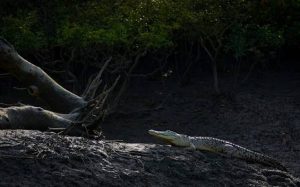
A kingfisher may land briefly on a branch. A crocodile can lie almost motionless along a muddy bank. A monkey may move through the vegetation. Birds appear around the edges of waterways before disappearing again into the forest.
And then there are the moments when nothing happens.
For a few minutes, the only sounds may be the boat, the water and distant birds.
That silence is not empty.
It is part of what makes the Sundarbans feel wild.
The possibility of seeing a tiger adds another layer of anticipation. But the forest is not a place where wildlife should be treated as guaranteed entertainment. Animals are difficult to find precisely because the habitat is dense and the landscape is enormous.
A responsible visit should therefore focus on experiencing the ecosystem rather than chasing a particular animal.
How Travellers Can Help Protect the Forest
Visitors have a role to play in keeping the Sundarbans healthy.
The most important principle is simple: leave the forest as you found it.
That means avoiding litter, respecting wildlife distances, following protected-area regulations and listening to local guides and authorities. Boats should operate in ways that minimize disturbance, particularly around sensitive habitats and wildlife.
Choosing responsible tourism operators also matters.
Tourism can create income for local communities and demonstrate that protecting the forest has economic value. But tourism that becomes careless, overcrowded or damaging can create another pressure on an already vulnerable ecosystem.
The best experience is therefore not necessarily the one that gets closest to a tiger.
It is the one that allows you to experience the forest without becoming part of the problem.
Why the Sundarbans Matters to the World
It would be easy to see the Sundarbans as a regional conservation issue belonging only to India and Bangladesh.
It is much more than that.
The Sundarbans mangrove forest represents a type of ecosystem that exists in many tropical and subtropical coastlines around the world, yet is increasingly under pressure from development, pollution, climate change and habitat loss.
What happens here offers lessons far beyond the Bay of Bengal.
The Sundarbans demonstrates how a healthy coastal ecosystem can support wildlife, store carbon, stabilize shorelines, provide nursery habitats for aquatic life and support human communities at the same time.
It also demonstrates the consequences of treating those functions as separate.
Destroy the mangroves and you do not simply lose trees.
You can lose habitat.
You can weaken coastal protection.
You can disrupt fisheries.
You can increase pressure on wildlife.
You can make communities more vulnerable.
The value of the forest therefore lies partly in its interconnectedness.
A Wilderness That Cannot Be Replaced
Perhaps the most compelling thing about the Sundarbans is that it does not need to look dramatic to be extraordinary.
There are no towering mountains rising above the horizon. There are no enormous waterfalls or sweeping savannahs filled with thousands of grazing animals.
Instead, there are mangrove roots disappearing into mud, narrow waterways reflecting the sky and islands covered in dense vegetation.
Yet beneath that seemingly quiet landscape is an ecosystem of extraordinary complexity.
The tides are moving.
Fish are sheltering among roots.
Birds are feeding along the mudflats.
Crocodiles are waiting in the water.
Dolphins move through the wider waterways.
And somewhere beyond the vegetation, a Bengal tiger is navigating one of the strangest habitats occupied by any big cat on Earth.
That is what makes the Sundarbans mangrove forest worth protecting.
It is not valuable simply because it is large or because it contains a famous animal. It is valuable because an entire living system still functions here, a system created by rivers, tides, mangroves, wildlife and people over generations.
The Future of the Sundarbans Mangrove Forest
The future of the Sundarbans mangrove forest will depend on whether people can protect that interconnected system while allowing it to continue changing naturally.
That will require cooperation between India and Bangladesh, strong conservation programmes, responsible management of natural resources, protection of wildlife and meaningful involvement of communities living around the forest.
It will also require the wider world to recognize that mangrove forests are not wastelands waiting to be developed.
They are among the most valuable coastal ecosystems on the planet.
The Sundarbans has already survived enormous environmental changes over its long history. Its rivers have shifted, islands have appeared and disappeared, and the tides have continued to reshape the landscape.
But resilience should never be mistaken for invincibility.
A forest can adapt, but it still needs space, functioning waterways, healthy wildlife populations and protection from unnecessary human pressure.
The goal should not be to freeze the Sundarbans in time.
It should be to make sure the natural processes that created it can continue.
A Forest Worth More Than Its Famous Tiger
When people hear the name Sundarbans, the Bengal tiger is often the first image that comes to mind.
That tiger deserves the attention.
But the deeper story is the forest itself.
It is the mangrove roots holding sediment together. It is the tidal water carrying nutrients through the islands. It is the mudflat where birds feed, the creek where fish find shelter and the coastline protected by dense vegetation. It is also the communities whose lives and livelihoods remain connected to the forest.
The tiger is simply one extraordinary expression of this much larger system.
Protecting the tiger means protecting its habitat. Protecting its habitat means protecting the waterways and mangroves. Protecting those mangroves means protecting a coastline, a wetland, countless other species and the ecological processes that keep the delta alive.
That is why the Sundarbans mangrove forest deserves more than admiration from a distance.
It deserves protection.
Because once a place this complex is lost, it cannot simply be recreated by planting a few trees.
The Sundarbans is a living wilderness shaped by water, time and countless forms of life. Its future will ultimately depend on whether humans can learn to work with that system rather than against it.
And if we succeed, the mangroves will continue to rise from the mud, the tides will continue to move through their channels, and somewhere in the green maze, the Bengal tiger will continue swimming across the water.