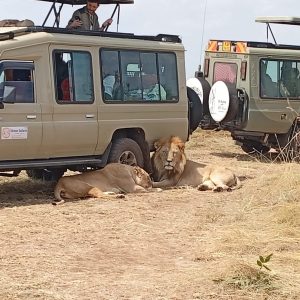
Imagine sitting in an open safari vehicle in the heart of Kenya’s Maasai Mara as a lion strolls past just a few meters away. Your heart races, your camera is ready, and yet the lion barely gives you a glance before continuing on its way. For many first-time safari visitors, the question comes naturally: why don’t predators attack safari vehicles?
It’s one of the biggest mysteries of an African safari. After all, lions, leopards, cheetahs, and hyenas are powerful predators capable of taking down animals much larger than a human. So why do they often ignore vehicles carrying people?
The answer lies in a fascinating combination of animal behavior, learned experiences, and responsible safari practices. Predators do not view safari vehicles the same way humans do, and experienced guides work hard to ensure wildlife encounters remain safe and respectful for both visitors and animals.
In this guide, we’ll explore the science behind why predators rarely attack safari vehicles, what happens when people break safari rules, and how ethical wildlife viewing has helped create the extraordinary safari experiences that millions of travelers enjoy every year.
Why Don’t Predators Attack Safari Vehicles? It Starts With How They See Them
One of the biggest misconceptions is that lions or leopards clearly recognize every person sitting inside a safari vehicle. In reality, wildlife biologists believe many large mammals perceive a vehicle carrying still, seated passengers as a single, unfamiliar but non-threatening object rather than a collection of individual humans.
This doesn’t mean predators are fooled into thinking the vehicle is another animal. Instead, they evaluate it based on experience.
For decades, safari vehicles in Kenya’s national parks and conservancies have behaved in predictable ways. They drive along designated tracks, stop briefly to observe wildlife, and then move on without chasing, threatening, or competing with animals. Because of these repeated, harmless encounters, many predators have become habituated to their presence.
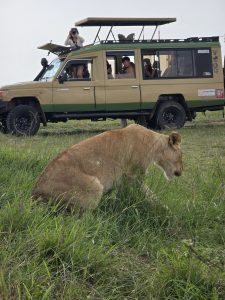
Habituation is often misunderstood. It does not mean animals become tame or domesticated. Wild predators remain just as capable of defending themselves or hunting as they always have. Habituation simply means they have learned that safari vehicles, when operated responsibly, usually do not pose a danger and are not worth reacting to.
This distinction is important because it explains why a lion may walk calmly past a vehicle one moment yet become alert if a person suddenly stands up or steps outside.
Safari Vehicles Don’t Behave Like Prey
Predators hunt because they need food, but hunting is also costly. Chasing prey requires enormous amounts of energy, and failed hunts are common. As a result, predators constantly weigh whether something is worth pursuing.
Safari vehicles don’t trigger the cues that predators associate with prey.
Unlike antelopes, zebras, or wildebeest, a vehicle:
- Doesn’t flee in panic.
- Doesn’t move like a living animal.
- Doesn’t produce natural prey sounds.
- Doesn’t display the body language predators instinctively recognize.
To a lion or cheetah, a Land Cruiser is simply not part of the menu.
Even when a predator walks extremely close to a vehicle, it is usually moving through its territory, following prey, investigating scents, or choosing a resting spot, not stalking the people inside.
Many of the dramatic photographs seen on safari are actually moments of complete calm. A lion resting beside a vehicle may appear intimidating to us, but from the lion’s perspective, the vehicle is simply another stationary feature in its environment.
Why Remaining Seated Makes a Difference
One of the golden rules on safari is to remain seated unless your guide tells you otherwise.
This rule isn’t about making visitors more comfortable, it’s about maintaining the way wildlife perceives the vehicle.
When everyone stays seated, the outline of the vehicle remains consistent. If someone suddenly stands, waves their arms, or leans far outside, the vehicle’s familiar shape changes instantly. That unexpected movement can attract attention or make an animal cautious because it no longer matches the harmless object it has grown accustomed to seeing.
Large cats are exceptionally sensitive to movement. Sudden changes are far more likely to catch their attention than quiet, predictable behavior.
For this reason, guides often remind guests to avoid sudden movements even when excitement levels are high.
What Happens If Someone Gets Out of the Vehicle?
This is where everything changes.
Once a person steps out, the predator is no longer looking at a large object with passengers. It now sees an individual human standing alone in its environment.
Humans on foot behave very differently from vehicles. They have a recognizable shape, produce different sounds, and may unintentionally trigger defensive or investigative responses from nearby wildlife.
Importantly, leaving a vehicle doesn’t automatically mean a predator will attack. However, it significantly increases risk because the protective barrier created by the vehicle is gone.
This is why getting out of a safari vehicle is only permitted in designated safe areas or when specifically instructed by your guide or park authorities.
Even in places where no predators are visible, experienced guides know that wildlife can remain hidden in long grass, bushes, or riverbanks.
Why Experienced Safari Guides Matter
Professional safari guides do much more than drive from one wildlife sighting to another.
They spend years learning how animals behave, how to interpret warning signs, and how to position vehicles without causing unnecessary stress.
An experienced guide pays attention to details many visitors might miss, such as:
- Changes in an animal’s posture.
- Ear and tail movements.
- Vocalizations.
- Signs that an animal wants more space.
- The direction of approaching wildlife.
This knowledge helps guides decide when to stay longer at a sighting and when it’s better to quietly move away.
Responsible guides also ensure vehicles never block escape routes, surround animals, or pressure them into changing their natural behavior. These practices not only protect visitors but also contribute to ethical wildlife tourism.