At first glance, a zebra’s stripes may look like nature simply got creative. But those bold black-and-white patterns are far more than decoration. For centuries, scientists have wondered why zebras evolved such a distinctive appearance while many other African animals have much plainer coats.
Several explanations have been proposed, including camouflage, predator confusion, temperature regulation and protection from biting insects. While researchers continue to investigate the full purpose of the pattern, one explanation has gained particularly strong scientific support: zebra stripes may help protect them from biting flies.
Why Do Zebras Have Stripes?
Zebras live in environments where horseflies and other blood-feeding flies can be a serious nuisance. These insects can also transmit diseases, making them more than just an irritation.
Research has shown that the contrasting stripes can interfere with the way biting flies approach and land on zebras. Instead of making a smooth landing, the insects may struggle to navigate the rapidly changing visual pattern created by the alternating dark and light bands.
This could give zebras an evolutionary advantage by reducing the number of successful fly landings and potentially lowering their exposure to some fly-borne diseases.
It is a fascinating example of how a feature that looks decorative to humans can serve a very practical purpose in the wild.
Do Zebra Stripes Confuse Predators?
Another popular theory is that zebra stripes help confuse predators such as lions, particularly when zebras move together in large herds.
The sight of dozens of striped animals running across the savannah certainly looks confusing. However, research has not produced strong evidence that predator confusion is the main reason zebras evolved their stripes.
Lions are capable of identifying and tracking individual zebras, even when they are moving within a herd. For this reason, scientists generally consider the evidence for protection against biting flies stronger than the predator-confusion theory.
That does not make a moving zebra herd any less spectacular to watch.
Every Zebra Has Its Own Stripe Pattern
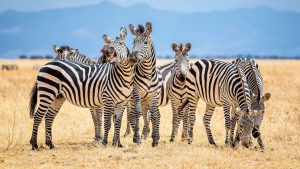
Although zebras may appear identical from a distance, each zebra has its own unique stripe pattern. The width, spacing and arrangement of the stripes can vary between individuals.
The differences become even more obvious when comparing zebra species. Plains zebras, which are widespread across Kenya, generally have broader stripes, while Grevy’s zebras, found mainly in northern Kenya, have narrower and more numerous stripes.

The unique patterns may also help individuals recognize one another. Foals, for example, can use visual cues to distinguish their mothers from other zebras in the herd.
So when you look at a group of zebras, you are not looking at dozens of identical animals. Each one carries a pattern that is uniquely its own.
Are Zebras Black With White Stripes?
This is one of the most common questions about zebras, and the answer is more interesting than it sounds.
Zebras develop dark skin, while the white areas of their coat are produced when pigment production is switched off in those hairs. The result is the dramatic black-and-white pattern that makes them so recognizable.
The pattern develops before birth, meaning a zebra foal is already born with its own distinctive arrangement of stripes.
The contrast may look unusual to us, but in the African wilderness, it is simply part of the zebra’s natural biology.
Why Don’t All Zebras Have the Same Stripes?
Zebra stripes are influenced by genetics, which is why individuals develop different patterns. Even zebras belonging to the same species can have noticeable differences in stripe width, spacing and shape.
There are also differences between species. Grevy’s zebras have particularly narrow, closely spaced stripes, while plains zebras have a different pattern that varies considerably between individuals.
These differences are another reminder that the familiar zebra pattern is not a simple design repeated across every animal. It is a complex feature that develops as each zebra grows.
The Mystery Isn’t Completely Solved
Despite decades of research, scientists cannot say with absolute certainty that zebra stripes serve only one purpose.
Protection from biting flies has some of the strongest supporting evidence, while other theories have explored camouflage, temperature regulation and social recognition. Some of these ideas may have contributed to the evolution of stripes, but they do not all have the same level of scientific support.
That uncertainty is part of what makes zebras so fascinating. An animal that seems familiar to anyone who has seen an African wildlife documentary can still hold evolutionary mysteries that scientists continue to investigate.
Seeing Kenya’s Striped Wildlife in the Wild
For safari visitors, zebras are among the easiest and most memorable animals to encounter across Kenya’s grasslands.

Plains zebras can be seen in destinations such as the Maasai Mara, Amboseli and Tsavo, often moving in large herds across open savannah. Grevy’s zebras are much more restricted in distribution and are mainly associated with northern Kenya, including areas around Samburu.
Watching a herd closely can reveal details that are easy to miss in photographs, the differences between individual patterns, the interactions between adults and young and the remarkable sight of hundreds of stripes moving across the landscape.
So, why do zebras have stripes? The answer is more fascinating than it first appears. While scientists continue to investigate the full purpose of the pattern, research strongly suggests that the stripes help make zebras less attractive or more difficult for biting flies to land on. Other theories, including predator confusion and social recognition, may also play a role, but the evidence is not equally strong for all of them.
What makes the pattern even more remarkable is that every zebra has its own unique arrangement of stripes. The next time you watch a herd crossing the Kenyan savannah, look beyond the familiar black-and-white appearance. Those stripes are not simply nature’s artwork, they are a fascinating adaptation shaped by evolution.