Kenya has earned a global reputation as one of the finest safari destinations on Earth, drawing visitors eager to witness extraordinary wildlife in breathtaking landscapes. While the country is home to the famous Big Five, few animals capture the imagination quite like its wild cats. From the thunderous roar of a lion echoing across the Maasai Mara to the silent, calculated movements of a leopard hidden in an acacia tree, these predators embody the untamed spirit of Africa.
The wild cats in Kenya are remarkably diverse. Some, like lions and cheetahs, are frequently spotted on game drives, while others, such as the elusive serval and caracal, remain hidden from all but the most patient observers. Each species has evolved unique adaptations that allow it to thrive in Kenya’s grasslands, forests, wetlands, and semi-arid landscapes.
Encountering one of these magnificent felines in the wild is more than just ticking an animal off a safari checklist. Watching a pride of lions interact, seeing a cheetah sprint across the plains, or catching a fleeting glimpse of a leopard emerging at dusk creates memories that stay with travelers long after they leave Kenya.
This guide explores the six wild cat species found in Kenya, where they live, what makes each one unique, and the best destinations to see them on safari.
Why Wild Cats in Kenya Make Every Safari Unforgettable
Kenya’s remarkable variety of habitats makes it one of Africa’s most important strongholds for wild cats. Sweeping savannahs, dense riverine forests, rocky hills, wetlands, and dry scrublands provide ideal conditions for different feline species to flourish.
Equally important is Kenya’s abundance of prey. Healthy populations of zebras, wildebeest, gazelles, impalas, buffaloes, warthogs, and smaller mammals sustain thriving predator populations throughout the country’s protected areas.
Kenya has also invested heavily in wildlife conservation through its network of national parks, national reserves, and community conservancies. These protected areas not only safeguard habitats but also support scientific research, anti-poaching initiatives, and community-led conservation programs that help ensure wild cats continue to thrive.
For safari enthusiasts, this translates into exceptional wildlife-viewing opportunities. Whether exploring the vast plains of the Maasai Mara, the elephant-filled landscapes of Amboseli, or the rugged wilderness of Samburu, visitors have excellent chances of encountering some of Africa’s most iconic predators in their natural environment.
Meet the Six Wild Cats Found in Kenya
Lion (Panthera leo)
No wild cat symbolizes Africa quite like the lion. Often called the “King of the Jungle”, despite inhabiting open grasslands rather than jungles, the lion is Kenya’s largest cat and one of its most celebrated safari attractions.
Unlike most other cats, lions are highly social animals. They live in prides consisting of related females, their cubs, and a coalition of males. This cooperative lifestyle allows them to defend territories, raise young together, and hunt prey much larger than a single lion could tackle alone.
Lionesses carry out most hunts, using teamwork to surround prey before launching a coordinated attack. Males, while capable hunters themselves, primarily defend the pride’s territory against rival males and other predators.
Adult male lions are instantly recognizable by their impressive manes, which vary in color from golden blond to almost black. Besides making them appear larger during confrontations, darker manes are often associated with maturity and good health.
Kenya supports one of Africa’s healthiest lion populations, making sightings common in several protected areas.
Best places to see lions in Kenya:
- Maasai Mara National Reserve
- Amboseli National Park
- Tsavo East National Park
- Tsavo West National Park
- Nairobi National Park
- Meru National Park
The annual Great Migration between July and October is particularly rewarding, as the abundance of wildebeest and zebras attracts large prides to the Maasai Mara.
Leopard (Panthera pardus)
If lions are Kenya’s most famous cats, leopards are undoubtedly its most mysterious. Solitary, stealthy, and incredibly adaptable, leopards are masters of camouflage, often remaining invisible even when they are only a few meters away.
Their beautifully patterned coats, covered in distinctive rosettes, blend seamlessly with dappled sunlight and vegetation. Combined with extraordinary patience and silent movement, this camouflage makes them among Africa’s most successful ambush predators.
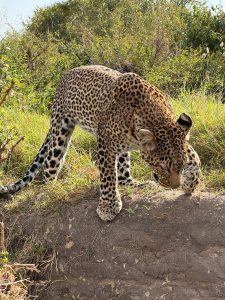
Leopards are exceptional climbers. After making a kill, they frequently drag prey high into trees to protect it from scavengers such as hyenas and lions. Seeing a leopard resting on a tree branch with an impala draped over a limb is one of the most iconic safari scenes in Africa.
Unlike lions, leopards prefer hunting alone. They feed on an astonishing variety of animals, ranging from small rodents and birds to antelopes, monkeys, and even young giraffes when the opportunity arises.
Although widespread across Kenya, leopard sightings require patience and experienced guides who know where these elusive cats are most likely to be found.
Best places to see leopards in Kenya:
- Maasai Mara National Reserve
- Samburu National Reserve
- Meru National Park
- Laikipia Conservancies
- Tsavo West National Park
Leopards are most active during early mornings, evenings, and at night, making dawn and dusk game drives particularly rewarding.
Cheetah (Acinonyx jubatus)
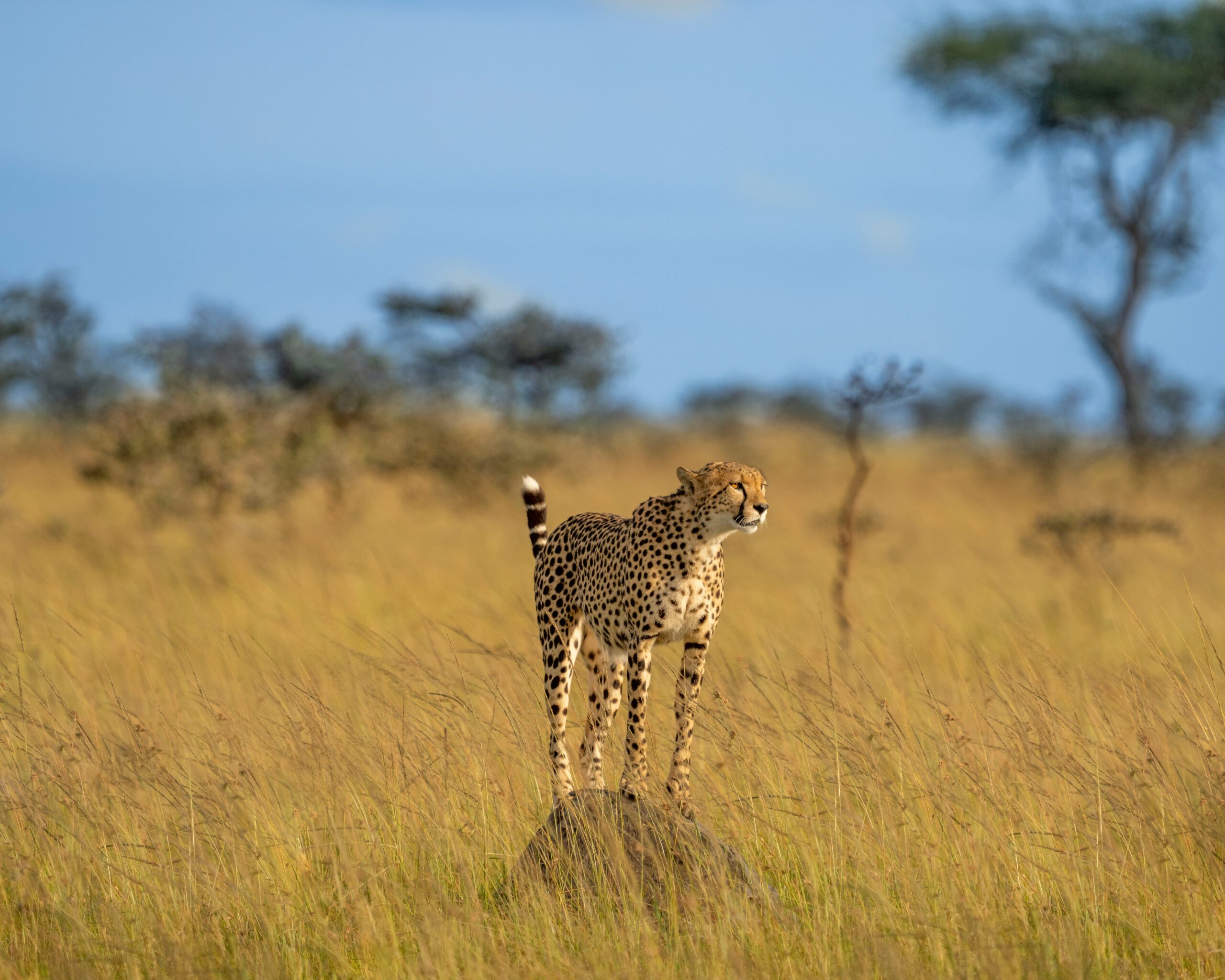
Few wildlife experiences compare to watching a cheetah accelerate across the African plains. As the fastest land animal on Earth, capable of reaching speeds of up to 100–120 km/h (62–75 mph) over short distances, the cheetah is built for speed rather than strength.
Unlike lions and leopards, cheetahs have slender bodies, long legs, a deep chest, and a lightweight frame that enables explosive bursts of acceleration. Their long tail acts as a rudder, helping them make sharp turns while pursuing agile prey. Distinctive black “tear marks” running from the inner corners of their eyes to the sides of their mouths help reduce glare from the sun, improving their focus during daytime hunts.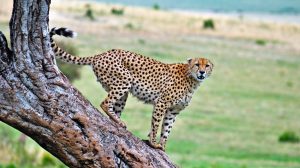
Cheetahs are primarily diurnal, meaning they hunt during the day when larger predators such as lions and hyenas are less active. They rely on exceptional eyesight to locate prey before stalking to within striking distance. Once close enough, they launch an astonishing sprint that usually lasts less than a minute. If the chase is unsuccessful, the cheetah must rest before attempting another hunt, as these high-speed pursuits consume enormous amounts of energy.
Unlike lions, cheetahs are generally solitary or live in small family groups. Females raise cubs alone, while males may form small coalitions, often made up of brothers, that cooperate to defend territories.
Although cheetahs are more vulnerable than other large predators because they can easily lose their kills to stronger animals, they remain one of Kenya’s most sought-after safari sightings.
Best places to see cheetahs in Kenya:
- Maasai Mara National Reserve
- Amboseli National Park
- Samburu National Reserve
- Ol Pejeta Conservancy
- Laikipia Conservancies
Open grasslands offer the best chance of spotting cheetahs, as they depend on wide visibility to detect prey and avoid larger predators.
Serval (Leptailurus serval)
While it rarely receives the same attention as lions or leopards, the serval is one of Kenya’s most fascinating wild cats. Medium-sized and remarkably elegant, it is instantly recognizable by its exceptionally long legs, oversized ears, and golden coat covered with bold black spots and stripes.
These physical adaptations make the serval a highly specialized hunter. Its large ears can detect the faint movements of rodents hidden beneath tall grass, while its long legs allow it to leap high into the air or pounce accurately on prey concealed below the vegetation. A serval can jump more than two meters vertically, making it one of Africa’s most accomplished small-mammal hunters.
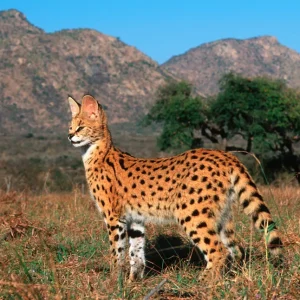
Unlike larger cats that rely on brute strength, servals feed mainly on rodents, birds, frogs, reptiles, and insects. Their impressive hunting success rate, often exceeding that of larger predators, is a testament to their precision and patience.
Servals prefer wetlands, floodplains, and grasslands where tall vegetation provides cover for both predator and prey. Because they are shy and often active during the early morning, evening, or night, sightings are less common than those of Kenya’s larger cats.
Best places to see servals in Kenya:
- Maasai Mara National Reserve
- Amboseli National Park
- Lake Nakuru National Park
- Aberdare National Park
- Lewa Wildlife Conservancy
Observing a serval patiently listening before launching into a graceful leap is a memorable experience for wildlife enthusiasts and photographers alike.
Caracal (Caracal caracal)
The caracal is one of Kenya’s most elusive feline predators. Although widespread across Africa, it is rarely seen on safari due to its secretive nature and preference for hunting under the cover of darkness.
Its most striking feature is the pair of long black tufts that extend from the tips of its ears. Scientists believe these distinctive ear tufts may play a role in communication between individuals and could also help camouflage the outline of the ears in tall vegetation.
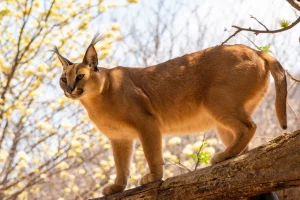
Caracals possess powerful hind legs that allow them to leap astonishing heights, enabling them to snatch birds directly from the air. This remarkable athletic ability has earned them a reputation as one of Africa’s most agile hunters.
Their diet includes hares, rodents, birds, small antelopes, reptiles, and occasionally young mammals. Adaptable and resilient, caracals inhabit dry savannahs, rocky hillsides, bushlands, and semi-arid regions across Kenya.
Because they are primarily nocturnal and extremely cautious around humans, even experienced safari guides consider a caracal sighting a special event.
Best places to see caracals in Kenya:
- Samburu National Reserve
- Tsavo East National Park
- Tsavo West National Park
- Laikipia Conservancies
- Meru National Park
Patience, knowledgeable guides, and a bit of luck are often required to encounter this remarkable predator.
African Wildcat (Felis lybica)
At first glance, the African wildcat may appear to be an ordinary domestic cat, but it is one of Africa’s most significant feline species. Genetic studies have shown that the African wildcat is the ancestor of today’s domestic cats, making it an important part of both natural and human history.
Despite their resemblance to household cats, African wildcats are true wild animals. They have longer legs, leaner bodies, longer tails with distinct dark rings, and a more cautious temperament. Unlike feral domestic cats, they have evolved to survive entirely in the wild without human assistance.
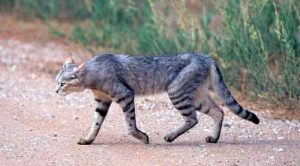
African wildcats are highly adaptable and occupy a wide range of habitats, including grasslands, savannahs, scrublands, and semi-arid environments. They hunt mainly at night, feeding on rodents, birds, reptiles, insects, and other small animals.
One of the greatest conservation concerns for the species is hybridization with domestic cats. As human settlements expand closer to wildlife habitats, interbreeding threatens the genetic integrity of wild populations.
Although they are not often highlighted during safaris, spotting an African wildcat offers a fascinating glimpse into the evolutionary origins of one of humanity’s most familiar companions.
Best places to see African wildcats in Kenya:
- Samburu National Reserve
- Tsavo East National Park
- Meru National Park
- Laikipia Conservancies
- Amboseli National Park
Where to See Wild Cats in Kenya
Kenya offers countless opportunities to encounter wild cats, but some destinations consistently provide exceptional sightings thanks to their diverse habitats, abundant prey, and experienced safari guides.
Maasai Mara National Reserve is widely regarded as the country’s premier destination for wild cats. Its expansive grasslands support healthy populations of lions, leopards, cheetahs, and servals. During the Great Migration, predator activity increases as millions of wildebeest and zebras move through the reserve.
Samburu National Reserve provides a different safari experience in Kenya’s northern semi-arid landscapes. Leopards are frequently seen along the Ewaso Nyiro River, while cheetahs, caracals, and African wildcats also inhabit the reserve.
Amboseli National Park combines spectacular views of Mount Kilimanjaro with excellent opportunities to observe lions, cheetahs, servals, and African wildcats roaming its open plains.
Tsavo East and Tsavo West National Parks, together forming one of the largest protected ecosystems in Africa, shelter healthy populations of lions, leopards, caracals, and African wildcats. The vast wilderness rewards travelers seeking a quieter safari experience away from larger crowds.
Meru National Park remains one of Kenya’s hidden gems. Its varied habitats support nearly all of the country’s wild cat species, and the park’s lower visitor numbers often allow for more intimate wildlife encounters.
Private conservancies in Laikipia and Lewa also offer outstanding predator sightings, particularly for travelers interested in exclusive game drives, walking safaris, and conservation-focused experiences.