Most travelers assume that safari sightings are based on luck. They imagine that guides simply drive around until they find animals by chance. In reality, professional guides rely on advanced safari guide skills developed over years of experience in the wild.
These skills allow them to interpret the landscape, understand animal behavior, and predict wildlife movement with surprising accuracy. What looks like a quiet bush to a visitor is actually a detailed story unfolding in real time for an experienced guide.
Understanding how safari guides find animals helps travelers appreciate that every sighting is the result of knowledge, observation, and timing, not coincidence.
Reading Animal Tracks in the Wild
One of the most important safari tracking skills is reading animal footprints. Every species leaves distinct tracks that reveal valuable information.
For example:
- Lion tracks are round and powerful
- Leopard tracks are smaller and more compact
- Elephant tracks are large and circular, often deeply pressed into the soil
Experienced guides can determine:
- How recently the animal passed
- The direction of movement
- Whether the animal was walking, running, or hunting
Tracking wildlife is widely recognized by conservation organizations such as the African Wildlife Foundation as an important method for studying animal behavior and ecosystem dynamics.
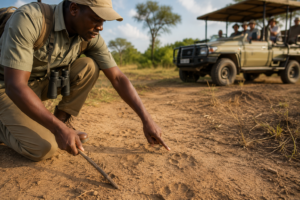
This skill is often used during game drives in destinations like Maasai Mara safaris and walking safaris where fresh tracks provide the first clue to nearby wildlife.
Listening to Alarm Calls in the Bush
The African bush is constantly communicating. One of the most powerful safari guide skills is the ability to interpret alarm calls from animals.
Species such as:
- Vervet monkeys
- Impalas
- Certain bird species
will alert others when predators are nearby.
A sudden wave of alarm calls in one direction often signals the presence of a predator such as a lion or leopard.
These sound patterns are closely studied in ecosystems managed by the Kenya Wildlife Service, which monitors wildlife behavior across national parks and reserves.
For travelers, this is one of the most fascinating parts of understanding how safari guides find animals. They are not just looking, they are listening.
Reading Bird Behavior as Natural Signals
Birds are one of the most important tools in wildlife tracking. Their behavior often reveals hidden activity on the ground.
Key examples include:
- Vultures circling overhead – possible predator kill site
- Oxpeckers gathering – large mammals nearby
- Sudden bird silence – predator presence
In many East African ecosystems, bird activity is used as an early warning system for wildlife movement.
Conservation areas such as the Maasai Mara National Reserve rely on this natural interaction between species to better understand ecosystem health and animal distribution.
This is a core part of advanced safari tracking skills used by professional guides.
Understanding Animal Behavior Patterns
Another essential element of safari guide skills is predicting animal behavior based on daily and seasonal patterns.
Most animals follow predictable routines:
- Lions rest during midday heat and hunt in early morning or evening
- Elephants travel to water sources regularly, especially in dry seasons
- Leopards prefer hidden resting spots and are most active at night
By understanding these patterns, guides can make educated predictions about where animals are likely to be at a specific time.
This is a key reason why experienced guides are so effective at delivering consistent sightings on safaris.
Spotting Small Clues Most Tourists Miss
To an untrained eye, the bush may look still. To a guide, it is full of information.
Small indicators include:
- Fresh animal dung
- Broken branches
- Flattened grass
- Dust clouds in the distance
- Strong natural scents carried by wind
Each of these clues helps guides build a mental picture of recent wildlife activity.
These subtle observations are a major part of safari tracking skills, allowing guides to follow animals even when they are not visible.
Using Deep Local Knowledge of the Ecosystem
Experience is one of the strongest tools in guiding. Many professional guides spend years working in the same ecosystems, learning the land intimately.
They understand:
- Territories of different lion prides
- Seasonal movement routes of elephants
- Leopard hiding areas
- Migration timing patterns
This local knowledge significantly improves their ability to interpret signs quickly and accurately.
It is one of the most overlooked but powerful safari guide skills in the industry.
Adapting to Weather and Seasonal Changes
Wildlife behavior changes depending on rainfall, temperature, and food availability.
During dry seasons:
- Animals gather near rivers and waterholes
- Wildlife sightings become more concentrated
During wet seasons:
- Animals spread out across wider areas
- Tracking becomes more challenging
According to ecological studies supported by the African Wildlife Foundation, seasonal movement patterns are essential to understanding predator-prey balance in savannah ecosystems.
Guides constantly adjust their search strategies based on these environmental changes.
Why Safari Guide Skills Matter to Travelers
A safari is not just about seeing animals, it is about understanding the environment that makes those sightings possible.
Strong safari guide skills transform a game drive into an educational experience where travelers learn:
- How ecosystems function
- How animals communicate
- How predators and prey interact
- How nature maintains balance
When travelers understand how safari guides find animals, every sighting becomes more meaningful.
A lion resting under an acacia tree or elephants walking across the plains is no longer random, it is part of a larger ecological story interpreted by a skilled guide.
At Bison Safaris, our experienced guides use advanced tracking knowledge, deep local expertise, and real time interpretation of wildlife behavior to create unforgettable safari experiences.
From Maasai Mara safaris to other East African destinations, every journey is guided by professionals who understand the land like a living map.
Instead of simply observing wildlife, travelers get to understand the hidden language of the African bush through expert guidance.