Imagine watching a black rhino emerge from a thicket at dawn, its powerful silhouette outlined against the golden plains. Nearby, a herd of elephants moves quietly toward a watering hole while a pair of endangered Grevy’s zebras graze peacefully in the distance. For many travelers, these are unforgettable safari moments. Yet behind every wildlife encounter lies a much larger story, one of relentless conservation, scientific research, dedicated rangers, local communities, and sustainable tourism working together to ensure these species continue to survive.
Kenya is celebrated worldwide for its breathtaking landscapes and extraordinary wildlife, but it is also recognized as one of Africa’s leading conservation success stories. Over the decades, the country has developed innovative approaches to protecting endangered species, combining modern technology with traditional conservation practices and community participation. While challenges such as habitat loss, climate change, illegal wildlife trade, and human-wildlife conflict remain significant, Kenya has demonstrated that determined conservation efforts can reverse population declines and restore hope for some of the continent’s most threatened animals.
Understanding how Kenya protects endangered wildlife offers a deeper appreciation of every safari experience. It reveals that national parks are more than beautiful destinations, they are carefully managed ecosystems where wildlife, local communities, researchers, conservationists, and tourism operators all play essential roles in preserving Africa’s natural heritage.
We believe that every safari should be more than a journey through spectacular landscapes. It should also be an opportunity to understand the remarkable conservation work that safeguards Kenya’s wildlife for future generations. This guide explores the strategies, partnerships, and success stories that have made Kenya a global leader in wildlife conservation.
Why Wildlife Conservation Matters in Kenya
Wildlife is deeply woven into Kenya’s identity. From the vast savannahs of the Maasai Mara National Reserve to the snow-capped slopes of Mount Kenya National Park, the country’s extraordinary biodiversity attracts millions of visitors while supporting ecosystems, livelihoods, and cultural traditions.
Tourism contributes significantly to Kenya’s economy, with wildlife safaris remaining one of its biggest attractions. Thousands of jobs, from safari guides and lodge staff to park rangers and researchers, depend directly or indirectly on healthy wildlife populations. Protecting endangered species therefore supports both biodiversity and local livelihoods.
Conservation also helps maintain ecological balance. Predators regulate herbivore populations, elephants shape vegetation, pollinators support plant reproduction, and scavengers such as vultures help prevent disease by removing carcasses. The loss of even one species can trigger changes throughout an ecosystem.
Kenya’s conservation efforts are guided by laws, scientific research, and long-term management plans, primarily coordinated by the Kenya Wildlife Service (KWS) together with county governments, conservation organizations, private conservancies, and local communities.
Kenya’s Most Endangered Wildlife
Before exploring how Kenya protects endangered wildlife, it is important to understand which species are most at risk and why they require intensive conservation efforts.
Black Rhino
The black rhino remains one of Kenya’s greatest conservation priorities.
During the 1970s and 1980s, rampant poaching driven by the illegal horn trade caused Kenya’s black rhino population to collapse dramatically, from around 20,000 individuals in the 1960s to fewer than 400 by the mid-1980s.
Today, thanks to decades of intensive conservation, Kenya has become home to one of Africa’s largest black rhino populations. Strict protection measures, secure sanctuaries, translocation programs, and continuous monitoring have enabled populations to recover steadily.
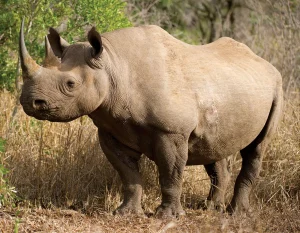
Visitors have excellent chances of seeing black rhinos in destinations such as:
- Ol Pejeta Conservancy
- Lake Nakuru National Park
- Nairobi National Park
- Solio Game Reserve
- Lewa Wildlife Conservancy
- Meru National Park
Explore more in our guide on the Best Places to See Endangered Rhinos.
Mountain Bongo
Hidden within Kenya’s montane forests lives one of Africa’s rarest antelopes, the mountain bongo.
Recognizable by its rich chestnut coat marked with striking white stripes, this shy forest antelope is found only in Kenya. Habitat loss, disease, illegal hunting, and shrinking forest cover caused wild populations to decline dramatically over several decades.
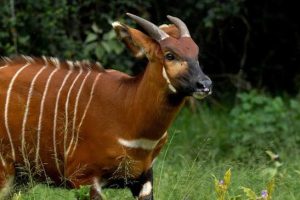
Today, conservationists are working to restore mountain bongo populations through captive breeding, habitat restoration, forest protection, and carefully planned reintroductions into protected forests such as the Mount Kenya and Aberdare ecosystems.
The mountain bongo has become a powerful symbol of Kenya’s commitment to restoring species that once stood on the brink of extinction.
Grevy’s Zebra
Unlike the more common plains zebra, Grevy’s zebra is instantly recognizable by its narrow stripes, large rounded ears, and white belly.
Over the past few decades, its population has declined because of habitat fragmentation, competition with livestock, drought, and limited access to water.
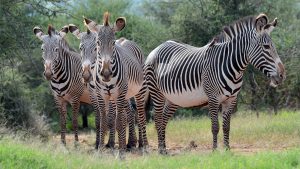
Northern Kenya now serves as the global stronghold for the species, with conservation programs focusing on:
- Community-led monitoring
- Water resource management
- Habitat protection
- Veterinary interventions
- Population research
The best places to encounter Grevy’s zebras include Samburu National Reserve, Buffalo Springs National Reserve, and surrounding community conservancies.
Read more about it in our guide to The Grevy’s Zebra.
Hirola
Often called the “world’s rarest antelope,” the hirola exists naturally only in northeastern Kenya and a small neighboring region of Somalia.
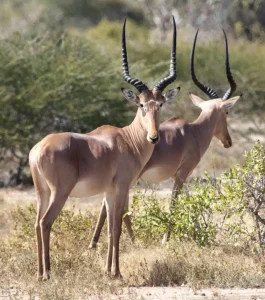
With fewer than a thousand individuals remaining in the wild, every population is closely monitored.
Conservation initiatives include:
- Predator management
- Community conservancies
- Protected enclosures
- Grassland restoration
- Scientific population surveys
Although rarely seen by visitors, the hirola represents one of Kenya’s most important conservation priorities.
African Wild Dog
African wild dogs once ranged across much of Kenya but suffered severe declines due to habitat fragmentation, disease transmission from domestic dogs, road accidents, and conflict with livestock owners.
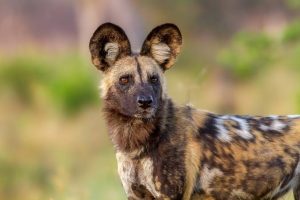
Fortunately, populations are recovering in several landscapes through improved habitat connectivity, disease control programs, and increased community participation.
Visitors may encounter them in:
- Laikipia Conservancies
- Maasai Mara ecosystem
- Tsavo ecosystem
- Samburu landscape
Their return demonstrates how protecting entire ecosystems benefits multiple species simultaneously.
Rothschild’s Giraffe
The Rothschild’s giraffe is one of the world’s most threatened giraffe subspecies.
Kenya has played a leading role in securing its future through carefully managed translocations to protected areas where populations can grow safely.
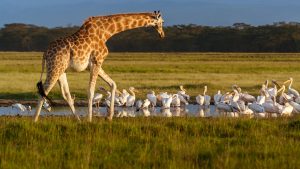
Important populations occur in:
- Lake Nakuru National Park
- Ruma National Park
- Soysambu Conservancy
- Mwea National Reserve
These conservation efforts have significantly improved the outlook for this iconic species.
Vultures
Although often overlooked by safari visitors, vultures are among Africa’s most valuable wildlife species.
They prevent disease outbreaks by consuming carcasses before harmful bacteria spread through ecosystems.
However, poisoning, habitat loss, power line collisions, and illegal wildlife poisoning have caused several vulture species in Kenya to decline dramatically.
Protecting vultures now involves:
- Rapid poison response teams
- Community awareness campaigns
- Monitoring nesting sites
- Reducing veterinary drugs harmful to scavenging birds
Healthy vulture populations contribute to healthier ecosystems across Kenya’s protected landscapes.
The Biggest Threats Facing Kenya’s Endangered Wildlife
To fully appreciate how Kenya protects endangered wildlife, it is important to understand the pressures conservationists work against every day. While illegal poaching once dominated conservation headlines, today’s challenges are more complex and often interconnected.
Habitat Loss and Fragmentation
As Kenya’s human population grows, demand for farmland, settlements, roads, and infrastructure continues to expand. This development can divide once-connected ecosystems into isolated pockets, making it harder for wildlife to migrate, find mates, and access food and water.
Large mammals such as elephants, lions, and wild dogs require vast landscapes to thrive. When traditional migration routes are blocked by fences or development, conflicts with people become more common, and wildlife populations become increasingly vulnerable.
Protecting and reconnecting these habitats has become one of the most important priorities in modern conservation, a topic we’ll explore in the next section as we look at how Kenya protects endangered wildlife through protected areas, wildlife corridors, and community partnerships.