Sunbirds of East Africa (family Nectariniidae) are the continent’s brilliant answer to the Americas’ hummingbirds. These tiny, dazzling dynamos are famous for their iridescent plumage, acrobatic foraging, and crucial role as pollinators for a massive array of flowering plants and savanna flora.
Found throughout Kenya, Tanzania, Uganda, Rwanda, and parts of Burundi, sunbirds thrive in forests, savannahs, gardens, wetlands, and mountainous regions. While they are often compared to hummingbirds because of their nectar-feeding habits, sunbirds belong to a completely different bird family and have evolved their own unique adaptations for survival.
What Are Sunbirds?
Sunbirds belong to the family Nectariniidae, which consists of more than 140 species found across Africa, Asia, and parts of the Pacific. East Africa alone hosts dozens of species, many displaying dazzling metallic plumage that changes color depending on the angle of sunlight.

Unlike hummingbirds, which can hover for extended periods, most sunbirds prefer to perch while feeding. Their long, curved bills and brush-tipped tongues are perfectly adapted for extracting nectar from tubular flowers.
Although nectar is their primary food source, sunbirds also eat insects and spiders, providing essential protein, especially during the breeding season.
Why Are Sunbirds Called Nature’s Tiny Jewels?
Sunbirds are famous for their extraordinary colors. Depending on the species, their feathers shimmer with brilliant shades of emerald green, sapphire blue, ruby red, violet, bronze, turquoise, and golden yellow.

The vibrant colors are not created by pigments alone but by microscopic feather structures that reflect and refract sunlight, producing an iridescent effect. As a result, the same bird can appear different colors when viewed from different angles.
This dazzling appearance has made sunbirds some of the most photographed birds in Africa.
Physical Characteristics of Sunbirds
The Rainbow spectrum; sunbirds exhibits Sunbirds exhibit extreme sexual dimorphism. Males feature dazzling, metallic feathers in shades of violet, emerald, crimson, and sapphire, while females boast more camouflaged, earthy tones of olive and brown.

- Structural Coloration: Their radiant hues aren’t made from traditional pigments. Instead, microscopic platelets in their feathers refract light like a prism, causing the birds to shift colors depending on the angle of the sunlight.
- Intricate Weaving: They build remarkable, suspended hanging nests from fine grass, leaves, and spiderwebs
Other features of sunbirds of Africa include:
- Length ranges from 8–20 cm depending on the species.
- Long, slender, curved bills designed for nectar feeding.
- Brush-like tongues for collecting nectar.
- Bright iridescent plumage in males.
- Females are generally olive, gray, or yellowish for better camouflage.
- Fast, agile flight with rapid wingbeats.
Common Sunbird Species in East Africa
East Africa is home to an impressive variety of sunbird species, each with its own unique colors and preferred habitats.
Superb Sunbird (Cinnyris superbus)
It is relatively large, strikingly colorful passerine bird widely distributed across tropical rainforest, gallery forests, and lush savannas of sub-Saharan Africa.

Males display brilliant metallic green heads, scarlet breast bands, and deep blue underparts, making them a favorite among bird photographers. They produce a rapid, high-pitched song and a unique, nasal “kyyep” call that sounds remarkably like a puffback bird.
Variable Sunbird (Cinnyris venustus)
It is a small energetic bird known for its complex vocalizations and striking geographic variations. It is one of the most common sunbirds found across sub-Saharan Africa.
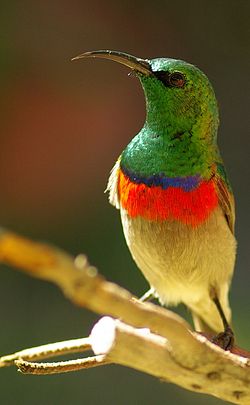
The males vary greatly in color depending on location, displaying combinations of green, blue, purple, and black while female lack the bright metallic colors. They are louder and more vocal than many other sunbirds. Their song is a rapid, high-pitched jumble of musical notes, often preceded by a sharp “tsip” or “tcheep” call. [1, 2, 3, 4]
It is one of the easiest sunbirds to observe in urban gardens.
Scarlet-chested Sunbird (Chalcomitra senegalensis)
It is a medium sized bird noted for its dramatic color scheme and bold, territorial behavior, it is one of the most widely recognized and frequently seen sunbirds across the open woodlands of sub-Saharan Africa.
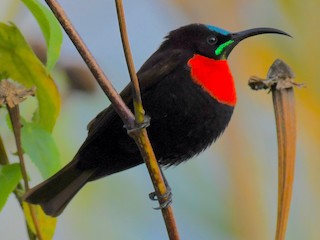
It commonly inhabits wetlands, riverbanks, and woodland areas throughout East Africa.
Tacazze Sunbird (Nectarinia tacazze)
Hunter’s Sunbird (Chalcomitra hunteri)
- This sunbirds of East Africa is a visually striking medium-sized nectar-feeding songbird native to east Africa and Horn of Africa.

- Hunter’s Sunbird is endemic to northern Kenya and southern Ethiopia, making it a prized sighting for dedicated birdwatchers. Male hunters have a brilliant scarlet-red breast patch while females one are duller with a heavily streaked yellowish white underside.
Its limited distribution adds to its conservation importance and appeal among birding enthusiasts.
Habitat and Distribution
The sunbirds of East Africa distribution is strictly dictated by altitude, rainfall and plant life.
They can be found in:
- Tropical rainforests
- Montane forests
- Acacia woodlands
- Savannahs
- Wetlands
- Coastal forests
- Botanical gardens
- Urban parks
- Flower-rich home gardens
Because flowering plants bloom at different times throughout the year, sunbirds often move locally in search of abundant nectar sources.
Feeding Habits
The feeding habits of sunbirds of East Africa are highly specialized, allowing them to fill a vital ecological role as pollinators. While famous for nectar, their diet is split into two critical categories:
-
- Nectar: Their primary source of carbohydrates and metabolic energy. They prefer nectar with high sugar concentrations (typically 15% to 25%), which they harvest from a massive variety of native and exotic flowers.
- Arthropods: Spiders, flies, ants, caterpillars, and beetles provide essential proteins, fats, and amino acids. This insect intake increases dramatically during the breeding season to feed growing chicks.
Breeding and Nesting
Breeding is highly synchronized with local weather patterns. It rarely occurs during dry, harsh months. They mostly breed on the onset or immediately after rainfall as rain triggers massive flower blooms and insect explosions. This ensures optimal nectar for parents and ample protein for chicks.
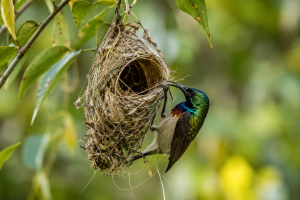
Sunbird nests are architectural marvels. They are built almost entirely by the female bird, though the male may accompany her to collect materials. Female sunbirds construct delicate hanging nests using grass, spider silk, bark fibers, feathers, and plant material. These nests are usually suspended from thin branches where predators find them difficult to reach.
A typical clutch contains one to three eggs. The female performs most of the incubation while both parents feed the chicks after hatching. Young sunbirds develop quickly and leave the nest within a few weeks.
Why Sunbirds Are Important to the Ecosystem
Although tiny, sunbirds share an evolutionary relationship known as co-evolution with native Africa flora.
Natural Pollinators
As they feed on nectar of one plant, they transfer pollen to stigma of another flower when they fly, helping plants reproduce successfully.
Pest Control
Adults primarily survive from carbohydrates from nectars, they switch to a strict insectivorous diet during nesting period. They capture thousands of soft-bodied insects to sustain the rapidly growing nestlings.
Biodiversity Indicators
Healthy populations of sunbirds often indicate thriving ecosystems with abundant native flowering plants. Their absence and presence tells biologists a great deal about local environmental health.
Supporting Forest Regeneration
sunbirds are foundational to the lifecycle of major Afromontane canopy trees and understory shrubs. Many flowering trees depend on birds like sunbirds for successful pollination.
Best Places to See Sunbirds of East Africa
Bird enthusiasts can encounter sunbirds throughout the region, but certain locations offer exceptional viewing opportunities.
Kakamega Forest, Kenya
One of Kenya’s richest birding destinations, home to numerous forest sunbird species and Kenya`s only remaining patch of the ancient Guineo-Congolian rainforest that once stretched across Central Africa.
Arabuko Sokoke Forest, Kenya
The largest remaining fragment of coastal forest in East Africa, sitting on a bed of ancient, infertile sands. A biodiversity hotspot where several rare and endemic bird species occur due to extreme isolation.
Aberdare National Park, Kenya
Excellent for mountain sunbirds, including the Tacazze Sunbird. The freezing nights require birds to have specific thermal adaptations.
Bwindi Impenetrable National Park, Uganda
Famous for both gorillas and over 350 bird species, including many colorful sunbirds.
Nyungwe Forest National Park, Rwanda
One of Africa’s oldest rainforests acting as a massive water catchment zone. Pristine canopy boardwalks allow birders to view elusive upper-canopy nectar-feeders at eye level.
Serengeti National Park, Tanzania
Although best known for wildlife safaris, the Serengeti also supports numerous sunbird species in woodland and riverine habitats.
Bird Photography Tips
Photographing sunbirds can be challenging because they move quickly between flowers.
For the best results:
- Visit gardens or flowering trees early in the morning.
- Use a telephoto lens (300–600 mm).
- Focus on flowering plants where birds regularly feed.
- Be patient and avoid sudden movements.
- Use a fast shutter speed to capture their rapid movements.
Soft morning light enhances the iridescent colors of their feathers.
Conservation Challenges
Although many sunbird species remain widespread, several face increasing pressure due to habitat loss.
Major threats facing sunbirds of East Africa include:
- Deforestation
- Agricultural expansion
- Climate change
- Urbanization
- Declining native flowering plants
- Pesticide use
Protecting forests and planting indigenous flowering plants can help sustain healthy sunbird populations.
Why Every Nature Lover Should Watch Sunbirds of East Africa
While Africa is famous for elephants, lions, and giraffes, the continent’s smaller wildlife is equally captivating. Sunbirds remind us that beauty often comes in the smallest forms. Their shimmering feathers, graceful movements, and essential ecological role make them one of East Africa’s greatest natural treasures.
Whether exploring the montane forests of Uganda, the savannahs of Tanzania, or the gardens of Kenya, keeping an eye on flowering shrubs may reward you with the sight of one of these dazzling sunbirds of East Africa. Watching a sunbird sip nectar while its plumage glows in the sunlight is a magical experience that showcases the incredible diversity of East Africa’s birdlife.
Frequently Asked Questions About Sunbirds of East Africa
What are sunbirds of East Africa?
Sunbirds of East Africa are small nectar-feeding birds in the family Nectariniidae. They are known for their brightly colored, iridescent feathers and their role as an important pollinator.
Where can I see sunbirds of East Africa?
Sunbirds of East Africa can be found across Kenya, Tanzania, Uganda, Rwanda, and Burundi in forests, savannahs, wetlands, botanical gardens, and even urban parks.
Are sunbirds the same as hummingbirds?
No. Although they share similar feeding habits, sunbirds and hummingbirds belong to different bird families and evolved independently.
What do sunbirds eat?
Sunbirds mainly feed on nectar but also consume insects, spiders, caterpillars, and other small invertebrates to supplement their diet.
What is the best time to watch sunbirds of East Africa?
Early morning is the best time, as sunbirds are most active while feeding on nectar-rich flowers. Flowering seasons also provide the highest chances of sightings.
- The Sunbirds of East Africa are among the region’s most dazzling bird species, captivating birdwatchers with their vibrant colors, remarkable agility, and essential role in pollination. Spotting these tiny jewels is a highlight of any East African safari adventure.