Kenya is a country where the journey can be just as interesting as the destination. One of the best examples is the Standard Gauge Railway, better known as the SGR Kenya or the Madaraka Express.
The modern railway connects Nairobi with Mombasa, linking Kenya’s capital with the Indian Ocean coast in a journey that takes travelers through some of the country’s changing landscapes. For tourists, the train can also become part of a much bigger holiday, connecting a city stay, a safari and a beach escape in one itinerary.
Since passenger services began in 2017, the Madaraka Express has become an important part of Kenya’s transport network. Today, travelers can choose between Economy, First and Premium Class on the Nairobi–Mombasa route, with several daily services and intermediate stops along the way.
If you are considering traveling by train during your Kenya holiday, this guide explains the SGR Kenya route, current 2026 fares, stations, train services, booking process and what to expect along the way.
What Is the SGR in Kenya?
SGR stands for Standard Gauge Railway, referring to the gauge of the railway track used for the modern railway network.
The passenger service operating between Nairobi and Mombasa is called the Madaraka Express. Kenya Railways also operates passenger services on the Nairobi–Suswa section, including a leisure service to Suswa on selected days.
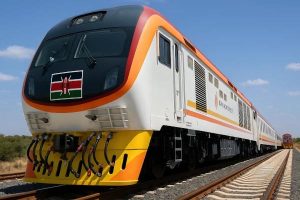
The Nairobi–Mombasa SGR was constructed as a modern railway connection between the two cities, with passenger services officially beginning in 2017.
It followed a much older chapter in Kenya’s railway history. The original railway reached Nairobi in 1899, helping transform the settlement into an important transportation and commercial center. More than a century later, the SGR created a new chapter in that story by introducing modern passenger rail travel along the Nairobi–Mombasa corridor. Explore more about the railway history in our guide to The ultimate Nairobi Railway Guide.
Where Does the SGR Kenya Route Go?
The main Madaraka Express route runs between Nairobi Terminus and Mombasa Terminus.
The train serves seven intermediate stations:
- Athi River
- Emali
- Kibwezi
- Mtito Andei
- Voi
- Miasenyi
- Mariakani
Nairobi and Mombasa are the two main termini, giving the route nine passenger stations in total.
For safari travelers, Voi is particularly important because it provides rail access to the Tsavo region. This makes the SGR more than a simple Nairobi-to-coast connection; it can also form part of an itinerary that combines rail travel with a wildlife safari.
SGR Kenya: Current Nairobi to Mombasa Train Schedule
As of 2026, Kenya Railways lists three main daily Madaraka Express departures between Nairobi and Mombasa:
Inter-County Train
The Inter-County service departs both Nairobi and Mombasa at 8:00 a.m.
Unlike the faster Express services, it makes scheduled stops at all seven intermediate stations:
Athi River → Emali → Kibwezi → Mtito Andei → Voi → Miasenyi → Mariakani
The Nairobi-to-Mombasa service is scheduled to arrive at Mombasa Terminus at approximately 2:00 p.m.
Afternoon Express
The Express service departs Nairobi and Mombasa at 3:00 p.m.
It makes a scheduled stop at Voi before continuing to the final destination. The Nairobi-to-Mombasa service is scheduled to arrive at approximately 8:08 p.m.
Night Train
The Night Train departs Nairobi and Mombasa at 10:00 p.m.
It also stops at Voi and allows passengers to travel overnight. The Nairobi-to-Mombasa journey is scheduled to arrive at approximately 3:35 a.m.
Train times can be revised, so passengers should confirm their schedule when booking.
How Much Does the SGR Cost in Kenya in 2026?
This is one area where travelers need to be particularly careful because older SGR information is still widely available online.
The current 2026 Madaraka Express fare revision lists the following adult fares for the full Nairobi–Mombasa journey:
| Class | One-way fare |
|---|---|
| Economy Class | KSh 1,500 |
| First Class | KSh 4,500 |
| Premium Class | KSh 12,000 |
Premium Class also has a published return fare of KSh 20,000.
The revised fare table also shows that shorter journeys cost less. For example, the Economy Class fare from Nairobi to Voi is KSh 1,050, while Nairobi to Mtito Andei is KSh 740.
Children’s SGR fares
Children aged 3 to 11 years pay half the applicable adult fare when traveling with adults.
Children below three years do not pay a fare, provided they do not require a separate seat. Passengers aged 12 and above pay the full adult fare.
For the full Nairobi–Mombasa journey, that means:
- Economy: KSh 750 for children aged 3–11
- First Class: KSh 2,250
- Premium Class: KSh 6,000
These figures are based on the published half-fare policy.
What Are the SGR Classes Like?
The Madaraka Express currently offers three classes on the full Nairobi–Mombasa route.
Economy Class
At KSh 1,500 one way, Economy Class is the most affordable option and is suitable for travelers who primarily want a comfortable way to get between Nairobi and the coast without spending heavily on the journey itself.
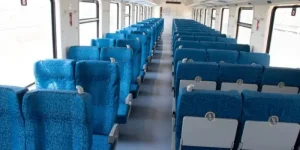
For travelers already budgeting for accommodation, park fees, game drives and other activities, Economy Class can make particular sense.
First Class
First Class costs KSh 4,500 one way for the Nairobi–Mombasa journey.
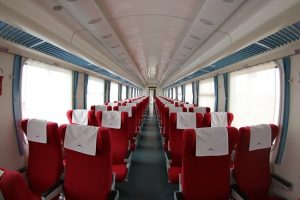
It provides a more spacious and premium travel experience and may be appealing to travelers who prefer additional comfort during the journey.
Premium Class
Premium Class is the highest passenger category on the Madaraka Express.
The current published fare is KSh 12,000 one way, with a return fare of KSh 20,000. The class was introduced as a more exclusive rail experience, with Kenya Railways describing it as a luxury service designed for travelers seeking a higher level of comfort.
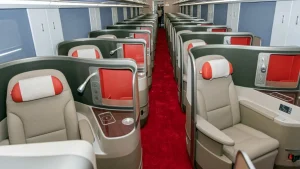
For most safari travelers, Economy or First Class will be sufficient. Premium Class is more suited to travelers who want to make the train journey itself part of the experience.
What Is the Difference Between the Inter-County and Express Trains?
The biggest difference is the number of stops.
The Inter-County train stops at all seven intermediate stations. The Afternoon Express and Night Train make a scheduled stop at Voi on the Nairobi–Mombasa route.
This difference can matter if you are traveling to or from a particular station.
For example, a traveler heading to Voi for a Tsavo safari should pay close attention to the service selected rather than assuming every SGR train stops at every station.
Can You Take the SGR to Tsavo?
Yes, and this is one of the most useful aspects of the railway for safari travelers.
Voi is one of the SGR’s intermediate stations and serves as an important access point for travelers heading into the Tsavo region.
A traveler could therefore arrange an itinerary such as:
Nairobi → SGR to Voi → Tsavo safari → Mombasa
or:
Nairobi → safari → SGR to Mombasa → beach holiday
The railway itself does not take passengers directly into a national park. Travelers still need a transfer from the station to their lodge, camp or safari vehicle.
This is where advance itinerary planning becomes important. A train ticket, accommodation booking and safari transfer all need to work together.
Can the SGR Be Part of a Kenya Safari?
Absolutely. One of the most interesting ways to use the SGR is to combine it with different types of Kenyan travel.
Imagine starting your holiday in Nairobi before heading into the wilderness for several days. After the safari, instead of spending another long day on the road, you could transfer to the railway and travel toward the coast.
A multi-stop holiday could look something like:
Nairobi → Amboseli → Tsavo → Mombasa → Diani Beach
Another itinerary could take the opposite direction:
Mombasa → SGR to Nairobi → Masai Mara → Nairobi
The best arrangement depends on the safari destinations, available time and whether the traveler wants to prioritize wildlife, coast, culture or a mixture of experiences.
What Can You See From the SGR?
One of the pleasures of traveling by train is that you are not simply moving from one destination to another, you can watch the country change outside your window.
The Nairobi area gradually gives way to more open landscapes as the train heads toward the coast. Further along the route, the environment becomes noticeably drier before the journey eventually approaches the coastal region.
The Voi section is particularly interesting for travelers because of its proximity to the Tsavo ecosystem.
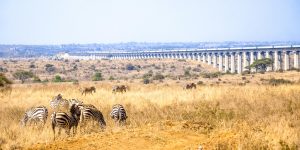
However, passengers should not board the SGR expecting a guaranteed wildlife-viewing experience. The railway is primarily a transport service, and sightings from the train are incidental rather than part of an organized game drive.
The real attraction is watching Kenya’s landscapes unfold during the journey.
Where Are the Nairobi and Mombasa SGR Stations?
The main passenger terminals are Nairobi Terminus and Mombasa Terminus.
Nairobi Terminus is in the Syokimau area, so travelers staying in central Nairobi need to allow enough time to reach the station.
Kenya Railways also provides a Link Train connecting Nairobi Central Station with Nairobi Terminus for passengers traveling on the Madaraka Express. The current published connecting services are timed around the main Madaraka Express departures and arrivals.
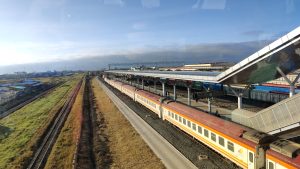
Mombasa Terminus is located in Miritini, rather than on Mombasa Island.
This means that travelers arriving by SGR should arrange onward transportation if their final destination is central Mombasa, Diani, Watamu or another coastal location.
How Early Should You Arrive at the SGR Station?
Kenya Railways advises passengers to arrive at least one hour before departure.
This allows time for document checks, security screening and boarding. The final boarding call is made 11 minutes before departure, while the platform gates close 10 minutes before the train leaves.
This is especially important for tourists who may be unfamiliar with the station.
If you are connecting from a safari, hotel or airport transfer, it is better to allow more time than to risk missing the train.
What Documents Do You Need?
Passengers should travel with their original identification documents.
Accepted documents listed by Kenya Railways include a Kenyan national identification card, valid passport, diplomatic identification, valid alien card, valid driving licence and other specified identification documents. Birth certificates are accepted for minors below 12 years.
International visitors should therefore keep their passport readily accessible throughout the journey.
How Do You Book the SGR in Kenya?
There are several recognized ways to book a Madaraka Express ticket.
Passengers can book:
- Online through the official Kenya Railways ticketing platform
- Over the counter at a Madaraka Express passenger station
- Through the *639# USSD service on Safaricom
Kenya Railways says tickets can be purchased up to 60 days before travel. A maximum of 10 passengers can be booked in one transaction through the online platform or USSD service.
For large groups of more than 20 passengers, Kenya Railways provides a separate group-booking arrangement.
Travelers should use official booking channels because Kenya Railways has previously warned passengers about fake SGR ticket-booking applications and unauthorized services.
How Much Luggage Can You Take on the SGR?
Luggage is another consideration when planning a safari by train.
Kenya Railways’ conditions of carriage specify luggage requirements and allow passengers to travel with baggage subject to the railway’s size and weight restrictions. Passengers should check the current conditions before traveling, particularly when carrying bulky safari equipment.
This is worth remembering if your trip includes cameras, binoculars, clothing and other safari equipment.
Packing light can make a multi-destination Kenya itinerary much easier.
Is the SGR Better Than Driving From Nairobi to Mombasa?
It depends on the type of trip you want. Driving gives you flexibility to stop wherever you like and can make sense when a vehicle is already part of a safari itinerary.
The SGR, however, offers a much more straightforward way to cover the Nairobi–Mombasa distance without spending the journey behind the wheel.
For tourists, another advantage is that the train can be incorporated into a larger itinerary without making the entire holiday road-based.
If your priority is speed, convenience and enjoying the journey, the SGR is an attractive option.
If your priority is flexibility and stopping at places along the way, traveling by road may be better.
SGR or Flight: Which Is Better for Tourists?
Flying remains the fastest option between Nairobi and Mombasa, but the SGR offers something a flight cannot: the experience of traveling through the country.
By air, the landscape disappears beneath you.
By train, it gradually changes outside your window.
For travelers who have enough time, this can make the SGR a worthwhile part of the holiday rather than simply a cheaper alternative to flying.
The choice ultimately depends on the itinerary. A traveler with only a few days may prefer to fly, while someone spending a week or more exploring Kenya may enjoy adding the railway journey.
The SGR Is Part of Kenya’s Travel Story
The Standard Gauge Railway is more than a modern transport project.
It is part of a much longer railway story that helped shape Kenya itself.
The original railway contributed to the growth of Nairobi and other settlements, while today’s SGR has created a modern connection between the capital and the coast.
For tourism, its importance is particularly clear. The railway makes it easier to combine different experiences within one holiday, urban Nairobi, wildlife destinations along the route and the beaches of the Indian Ocean.
It also gives visitors an opportunity to experience Kenya from a different perspective.
A safari is usually about getting off the road and into the wilderness.
The SGR is about sitting back, watching the country pass by and appreciating the transition between different landscapes.
Planning an SGR Journey as Part of Your Kenya Holiday
The best way to use the SGR is not necessarily to treat it as a separate attraction.
Instead, think about how it fits into the entire journey.
A traveler could spend a few days in Nairobi, continue into the Maasai Mara or Amboseli for a safari, then travel toward the coast for several days beside the Indian Ocean.
Another traveler might begin at the coast, take the Madaraka Express to Nairobi and continue to a safari destination.
There is no single perfect itinerary.
The important thing is to coordinate the train schedule, safari transfers, accommodation and activities so that one part of the trip does not interfere with another.
For travelers unfamiliar with Kenya, this is one area where a well-planned itinerary can make a significant difference.
The SGR Kenya experience has changed the way many travelers move between Nairobi and the coast.
With current 2026 fares starting at KSh 1,500 in Economy Class, the Madaraka Express remains an accessible option for travelers who want to experience Kenya by rail. First Class is currently KSh 4,500, while Premium Class costs KSh 12,000 one way on the full Nairobi–Mombasa route.
But the real appeal of the SGR is not simply its price or convenience.
It is the opportunity to watch Kenya change outside the window, from the surroundings of Nairobi, through the drier landscapes toward Tsavo, and eventually to the coast.
For travelers combining a safari with a beach holiday, the railway can become an important part of the itinerary itself.
Sometimes the journey is part of the adventure, and in Kenya, the SGR gives you a chance to experience it.