There are places in Kenya that seem to belong to a completely different world. Far from the busy safari routes of the Maasai Mara and Amboseli, and close to the Tanzania border in Taita-Taveta County, Lake Chala sits quietly inside an ancient volcanic crater.
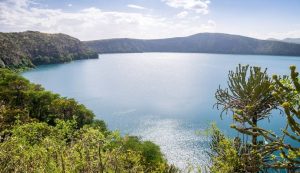
From above, the lake looks almost perfectly enclosed by the steep walls of its crater. Its clear waters contrast sharply with the surrounding vegetation, while Mount Kilimanjaro rises in the wider landscape to the west. Yet the most fascinating thing about Lake Chala is not simply how beautiful it looks. Beneath its calm surface lies an unusual water system, and within its depths lives a fish found nowhere else on Earth.
For travellers looking for a different side of Kenya, Lake Chala offers a combination of geology, wildlife, scenery and adventure that is easy to overlook.
Where Is Lake Chala?
Lake Chala is located in Taita-Taveta County in southeastern Kenya, close to the border with Tanzania. It lies approximately 8 kilometers north of Taveta and on the eastern side of Mount Kilimanjaro. The lake itself crosses the international boundary, making it a genuinely transboundary natural attraction shared by Kenya and Tanzania.
The Kenyan side can be reached from Taveta along the road towards the Kenya–Tanzania border before turning towards the lake. From the access point, reaching the water involves a descent down the steep crater landscape. Research conducted around Lake Chala describes the final approach as involving a walk down the crater, with some sections being particularly steep.
This relative remoteness is part of the attraction. Lake Chala does not have the same level of international recognition as Kenya’s famous safari destinations, and that gives visitors the opportunity to experience a remarkable landscape away from the crowds.
A Lake Born From Volcanic Activity
Lake Chala owes its existence to the volcanic forces that shaped this part of East Africa.
The lake occupies a volcanic crater or caldera on the eastern slopes of Mount Kilimanjaro. Scientific research places its formation hundreds of thousands of years in the past, while the surrounding landscape reflects the enormous volcanic activity that helped create the Kilimanjaro region.
The result is a striking natural basin surrounded by steep crater walls. Some parts of these walls rise roughly 100 to 170 meters above the lake, making the descent towards the water feel quite dramatic.
Unlike an ordinary lake lying across a broad valley, Lake Chala feels enclosed. The crater walls frame the water from almost every direction, giving the lake its distinctive appearance.
That volcanic origin also explains why the lake is so deep despite its relatively small size.
How Deep Is Lake Chala?
Lake Chala is surprisingly deep for a lake covering only a few square kilometers.
Its surface area is roughly 4.2 to 5 square kilometers, depending on the source and measurement used, while its maximum depth is around 98 meters. Kenya’s Wetlands Atlas gives an average depth of about 97 meters, while fisheries research records a maximum depth of 98 meters.
That combination of a relatively small surface area and great depth is one of the lake’s most remarkable characteristics.
Standing at the crater rim, it can be difficult to appreciate just how much water lies below the surface. The steep walls plunge towards a deep basin, creating an environment very different from Kenya’s large, shallow lakes.
The Water Beneath Lake Chala’s Surface
Perhaps the most fascinating feature of Lake Chala is that you do not see a major river flowing into it.
The lake has no known permanent surface inlet. Much of its water comes from underground groundwater systems associated with the Mount Kilimanjaro highlands. Kenya’s Wetlands Atlas describes the lake as being recharged by underground springs, while Kenya’s Ministry of Water has reported that approximately 80 percent of its inflow comes from groundwater.
Hydrogeological studies link the lake to the wider Kilimanjaro aquifer system, which extends across the Kenya–Tanzania border. Water originating from rainfall in the higher areas around Kilimanjaro infiltrates the volcanic ground and moves through the subsurface before contributing to the lake.
This hidden connection is one reason Lake Chala is so interesting. The lake may appear completely still and isolated, but beneath the surrounding landscape is a much larger movement of water that cannot be seen from the shore.
Why Does Lake Chala Look So Blue?
Visitors are often struck by the colour of Lake Chala.
Depending on sunlight, weather and viewing conditions, the water can appear deep blue, turquoise or shades of green. The steep crater walls and surrounding vegetation add to the dramatic contrast.
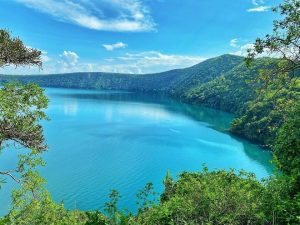
The lake’s relatively clear water is connected to its groundwater-fed nature, although its appearance can naturally change with light and environmental conditions. Rather than having one permanent colour, Lake Chala can look quite different from one visit to another.
Early in the morning, the surface can appear calm and dark beneath the crater walls. As sunlight reaches the water, the colour can become brighter and more vivid.
This changing appearance is part of what makes Lake Chala such an appealing landscape for photographers and nature lovers.
Home to a Fish Found Nowhere Else
Lake Chala is not only beautiful. It is also ecologically important because it supports a remarkable endemic fish.
The Lake Chala tilapia (Oreochromis hunteri) is restricted to Lake Chala and is found nowhere else in the world. A 2026 scientific review describes the species as critically endangered and highlights its extremely limited distribution.
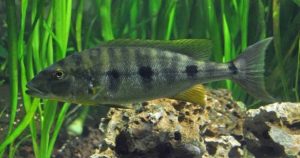
Its isolation within the lake has made it particularly interesting to scientists studying evolution and species development. Research indicates that the fish has been separated from related populations for a very long period, allowing it to develop as a distinctive lineage within the isolated crater-lake environment.
That makes Lake Chala more than a scenic attraction. It is also a small but important natural laboratory for understanding how species can evolve in isolated environments.
The lake’s ecosystem faces pressures, however, including habitat degradation and competition from introduced fish species. Protecting the lake therefore means protecting not just its scenery but also the unique life that exists within it.
Wildlife Around Lake Chala
The lake and its surrounding vegetation support a variety of wildlife and birdlife.
Kenya’s Wetlands Atlas identifies Lake Chala as an important repository of birdlife and highlights its ecological importance beyond the water itself. The surrounding crater landscape provides habitat for different species, making the area interesting for birdwatchers and nature enthusiasts.
The lake’s ecosystem also has a notable connection with crocodiles. Kenya’s Wetlands Atlas describes Lake Chala as having one of the higher crocodile population densities among Kenyan water bodies.
This is an important consideration for visitors. Lake Chala should not be treated like an ordinary swimming pool or recreational beach. Activities around the water should follow local guidance and safety instructions, particularly where wildlife is present.
What Can You Do at Lake Chala?
Lake Chala is best suited to travellers who enjoy nature, scenery and outdoor exploration rather than conventional beach tourism.
Hike Around the Crater
The steep crater landscape makes hiking one of the most rewarding ways to experience Lake Chala.
The approach to the water involves descending through the crater environment, while viewpoints around the rim provide different perspectives over the lake. The walk can be physically demanding in places, particularly because of the steep terrain and warm conditions.
A visit therefore becomes more than simply arriving at a viewpoint, taking a photograph and leaving. The landscape is part of the experience.
Enjoy the Scenery
Even travellers who are not interested in strenuous activities can appreciate Lake Chala from the surrounding viewpoints.
The combination of the crater walls, deep water, vegetation and the wider Kilimanjaro landscape makes the area particularly photogenic.
For photographers, early morning and later afternoon can provide beautiful natural light across the crater.
Birdwatching
The vegetation surrounding the lake provides opportunities for birdwatching. Because the lake forms part of a wider ecological landscape rather than existing in isolation, bird enthusiasts can spend time exploring the surrounding habitat as well as looking over the water.
A quiet walk can therefore reveal more than the dramatic scenery that first attracts visitors.
Explore the Wider Taveta Area
Lake Chala can also form part of a broader exploration of southeastern Kenya.
Taita-Taveta County is home to other natural attractions, including Lake Jipe, Tsavo’s vast wildlife areas and the dramatic landscapes around the Taita Hills. Combining several of these attractions can turn a visit to Lake Chala into a wider adventure through one of Kenya’s less-explored regions.
The Kenya–Tanzania Border Runs Through the Lake
One of Lake Chala’s most unusual features is its international location.
The lake straddles the Kenya–Tanzania border, meaning that its waters belong to a landscape shared by two countries. The Kenyan portion is relatively small compared with the overall lake, but the border adds another fascinating dimension to its story.
This is one of those geographical details that can completely change how you see a destination. What appears to be one enclosed lake is actually part of two national territories.
Visitors should, however, remember that an international border is not something to cross casually. Access to different parts of the lake should follow the applicable border and tourism regulations.
Why Lake Chala Deserves More Attention
Kenya has no shortage of famous lakes. Lake Victoria, Lake Nakuru, Lake Naivasha, Lake Turkana and Lake Bogoria are far better known among international travellers.
Yet Lake Chala offers something quite different.
It is small enough to feel intimate, deep enough to be surprising, old enough to have a remarkable geological story, and isolated enough to support a fish found nowhere else in the world.
It also demonstrates how much of Kenya’s natural heritage exists outside the country’s most heavily visited safari destinations.
For travellers who have already experienced the Maasai Mara or Amboseli and want to explore a quieter part of Kenya, Lake Chala offers an opportunity to see a landscape shaped by volcanoes, groundwater and time.
When Is the Best Time to Visit Lake Chala?
The best time depends on what you want from the experience.
For hiking and outdoor exploration, visitors generally benefit from planning around periods with favourable weather and avoiding conditions that can make the steep access routes slippery.
Clearer weather can also provide better views across the lake and surrounding landscape, while changing light throughout the day creates different colours across the water.
Because Lake Chala is not a mass-tourism destination, it is worth checking current local access arrangements, road conditions and any guidance from local authorities or tourism operators before travelling.
A Hidden Lake With a Story Beneath the Surface
Lake Chala does not announce itself with the scale of Lake Victoria or the dramatic wildlife reputation of the Maasai Mara. Instead, its appeal is quieter.
It is a deep crater filled with water that largely arrives through an invisible underground system. Its steep volcanic walls rise around a lake shared by Kenya and Tanzania. Beneath its surface lives an endangered fish found nowhere else on Earth.
And around it lies the wider landscape of Taveta, where volcanoes, wildlife, communities and cross-border ecosystems meet.
That is what makes Lake Chala worth discovering. It is not simply another beautiful lake in Kenya. It is a reminder that some of the country’s most fascinating natural stories are hidden in places that receive far less attention than the famous safari destinations.
For travellers willing to venture beyond the usual routes, this remarkable crater lake offers a very different way of experiencing Kenya.