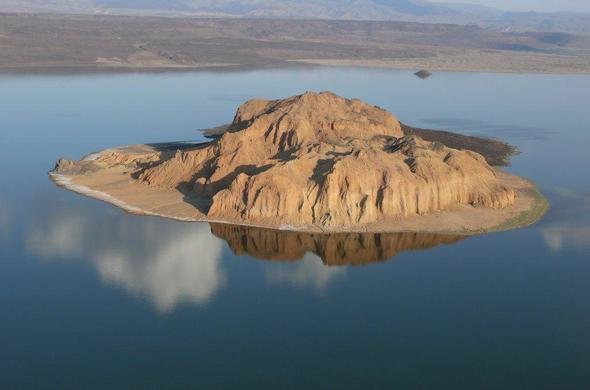
There are places in Africa where the silence can be deceptive. You may be standing among walls that look as though they have always belonged to the wilderness, with grass growing between stones and trees rising where houses once stood. There may be no busy streets, no market stalls and no sound of merchants arguing over the price of goods. It can be difficult to imagine that people once gathered here in their thousands. Yet they did.
Long before the skylines and highways of modern Africa, cities rose across the continent as centers of power, trade, religion and learning. Some controlled gold routes that stretched from the interior to the coast. Others stood at the meeting point of major civilizations, linking Africa with Arabia, India, Europe and Asia. Some became wealthy through trade across the Sahara, while others built monumental architecture that still leaves archaeologists trying to understand how it was created.
Then, in time, their fortunes changed. A trade route shifted. A kingdom weakened. Resources became harder to obtain. Political power moved elsewhere. Foreign powers disrupted established networks. In some cases, the reasons are still uncertain.
People gradually left. Buildings deteriorated. Nature began to reclaim the streets. And cities that had once mattered enormously became ruins.
That is what makes Africa’s lost cities so fascinating. They are not simply abandoned buildings scattered across the continent. They are fragments of much larger stories about the people who built them, the worlds they created and the connections that once stretched far beyond their walls.
Some are famous. Others remain surprisingly obscure. But together, they reveal an Africa whose history was far more urban, connected and sophisticated than the ruins alone might suggest.
Great Zimbabwe: The Stone City That Became a Symbol
Approaching the ruins of Great Zimbabwe today, it is easy to make the same mistake that generations of outsiders once made: to look at the enormous stone walls and imagine a mysterious city appearing almost inexplicably in the middle of southern Africa.
But Great Zimbabwe was not a mystery without the people.
It was built by the Shona, and its story stretches back to the 11th century. Over the following centuries, the settlement grew into the center of a powerful state, occupying a strategic position in a region where agriculture, cattle keeping and access to valuable resources supported a substantial population. By the 14th century, Great Zimbabwe had become the principal city of a major state extending across the gold-rich plateaus of southern Africa. UNESCO notes that its population exceeded 10,000 at its height. The scale of the place becomes more impressive when you realize that the ruins visible today are only remnants of a much larger urban landscape.
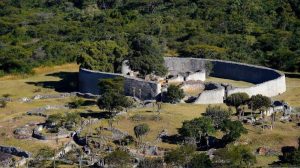
Great Zimbabwe covers almost 800 hectares, with its archaeological remains traditionally divided into the Hill Ruins, the Great Enclosure and the Valley Ruins. The walls were built from carefully shaped granite blocks without mortar, creating sweeping curves and towering structures that still dominate the landscape.
The Great Enclosure is perhaps the most famous. Its enormous elliptical wall seems almost too deliberate for a settlement that is now surrounded by open woodland. Inside were structures associated with the ruling elite, while other parts of the city contained residential areas and evidence of everyday life. The builders decorated some of the stonework with distinctive chevron and chequered patterns, demonstrating that the walls were not simply functional. They were expressions of craftsmanship, status and identity.
But stone was not what made Great Zimbabwe powerful. Its position within a wider economic system was far more important.
Gold from the surrounding region could move through networks towards the Indian Ocean coast. From there, goods travelled to distant markets. Archaeologists have found glass beads, Chinese and Persian porcelain, gold and Arab coins from Kilwa, as well as other objects that reveal the city’s participation in long-distance commerce.
Think about what that means.
Somewhere in the city, a person could have held an object that had travelled across the Indian Ocean from a place thousands of kilometers away. Great Zimbabwe may have been deep within the African interior, but it was not isolated from the wider world.
Its wealth and influence eventually made it one of the great urban centers of medieval southern Africa.
Then the city began to decline.
Around the middle of the 15th century, Great Zimbabwe was abandoned as a political capital. UNESCO associates the abandonment with pressures on the city’s hinterland, including the ability to supply enough food for a large population and the effects of deforestation. The political center shifted, and the decline of Great Zimbabwe helped create the conditions for the rise of other centers, including Khami.
The city disappeared from everyday life, but it never disappeared completely. Its walls remained.
So did the distinctive soapstone birds found at the site, objects that have become powerful symbols of Zimbabwe itself. The ruins are also still regarded as a sacred place by contemporary communities.
What makes Great Zimbabwe particularly important is not simply that it is old. It is that the archaeological evidence forces us to look at the past of southern Africa differently.
This was a society capable of building monumental architecture, organizing a substantial population and participating in international trade.
The city may have fallen silent. Its story did not.
Meroe: Where the Kingdom of Kush Left Its Pyramids in the Desert
Travel farther north and the landscape changes dramatically. The green surroundings of Great Zimbabwe give way to the reddish-brown hills and semi-desert landscapes of the Nile Valley. Here, near the Nile and Atbara rivers in present day Sudan, an ancient city once stood at the heart of one of Africa’s most powerful kingdoms.
Meroe was the center of the Kingdom of Kush. And if its name is unfamiliar to many modern travellers, its monuments should not be.
The pyramids of Meroe rise from the desert in tightly packed groups, their steep sides catching the sunlight. They immediately invite comparisons with Egypt, but the civilization that built them had its own identity, traditions and history.
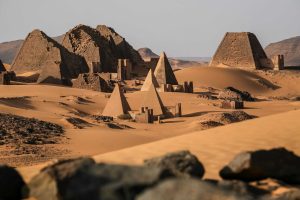
The Kingdom of Kush was a major power from around the 8th century BCE to the 4th century CE. At one stage, Kushite rulers controlled Egypt for close to a century, establishing what historians call Egypt’s 25th Dynasty. Later, the center of Kushite power moved south, and Meroe became the principal residence of the rulers and the main site of royal burials from around the 3rd century BCE.
That move south was significant.
Meroe was not simply a royal burial ground. It was a functioning urban center within a wider kingdom whose territory stretched across enormous parts of the Nile Valley. The remains tell a surprisingly varied story.
There are pyramids and temples, but there are also palaces, domestic buildings, industrial areas and evidence of sophisticated water management. Archaeologists have found evidence of ironworking and other forms of production, while ceramics and other remains reveal the wealth and commercial connections of the Kushite state.
In other words, the pyramids were only the most visible part of Meroe. Behind them was a living city. People needed food. Craftspeople produced goods. Workers processed materials. Religious ceremonies took place. Royal power had to be maintained. Water had to be managed in an environment that could be unforgiving.
Meroe also developed its own writing system, known as Meroitic, which remains only partly understood today. That unfinished understanding gives the city an additional layer of mystery.
There is something remarkable about standing before an ancient civilization whose monuments are clearly visible while parts of its written story remain difficult to fully interpret.
Eventually, Kush declined. By the 4th century CE, the kingdom’s power had faded and Meroe ceased to be the center of a major political state. Later Christian kingdoms emerged in the Middle Nile region, and much of the Kushite world gradually disappeared from political life.
The desert, however, preserved enough for the modern world to rediscover. The pyramids remained. So did the temples and remnants of the city.
Meroe is therefore more than an ancient ruin. It is evidence of a powerful African civilization that interacted with Egypt and the wider Mediterranean and Middle Eastern worlds while developing its own distinctive culture.
The pyramids may draw the eye first. But the city behind them is the real story.
Kilwa Kisiwani: The Island City That Was Once Richer Than It Looks Today
Imagine arriving on a small island off the coast of East Africa and finding the remains of a city built from coral stone.
There are mosques without congregations, walls without houses and pathways that lead through ruins rather than busy streets. It is difficult to imagine that this was once one of the great commercial centers of the Indian Ocean.
Kilwa Kisiwani, off the coast of present day Tanzania, was a Swahili trading city whose influence grew enormously between the 13th and 16th centuries. Its prosperity depended heavily on controlling maritime trade between the East African coast, Arabia, India and China. Gold and ivory from the African interior were exchanged for goods including silver, perfumes, Persian ceramics and Chinese porcelain.
The city was wealthy enough to mint its own currency. That single detail tells us how far it had come. Kilwa was not merely a stopping point for foreign merchants. It was a powerful commercial center with its own political and economic authority.
The city’s wealth was reflected in its buildings.
The Great Mosque began in the 11th century and was substantially enlarged in the 13th century. Its domes and vaulted spaces represented a remarkable achievement in coastal architecture, and its great dome remained the largest in East Africa until the 19th century.
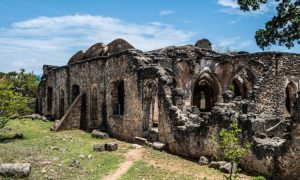
Then there was Husuni Kubwa, an enormous palace complex built around the early 14th century. Its remains include a large octagonal bathing pool and structures that suggest the considerable wealth of Kilwa’s ruling elite.
The city impressed visitors from far beyond East Africa.
When the famous Moroccan traveller Ibn Battuta arrived in 1331–1332, he described Kilwa as one of the most beautiful cities in the world. That description is difficult to reconcile with the ruins that stand there now. But it gives us a glimpse of what has been lost.
At its height, Kilwa would have been filled with merchants, sailors, craftsmen, religious scholars and residents whose lives were shaped by the movement of goods across the Indian Ocean.
Its story also reveals something important about Swahili civilization. The East African coast was not an isolated edge of the continent. It was part of a maritime world in which ideas, religions, languages, technologies and commodities moved constantly between Africa and Asia.
Then came disruption.
In the 16th century, the Portuguese established a fort on Kilwa Kisiwani, and the city’s decline began. Its commercial dominance weakened, and the once powerful port gradually lost the position that had made it prosperous.
Today, vegetation is slowly reclaiming parts of the ruins. Even more fascinating is the fact that much of the ancient city remains unexcavated.
Beneath the ground are houses, streets, burial areas and other traces of ordinary life waiting to be studied. The visible ruins are therefore only part of Kilwa’s story.
Perhaps that is why the island feels less like a finished archaeological site and more like a city that has simply paused.
Aksum: The Ancient Powerhouse That Connected Africa to the World
In the highlands of northern Ethiopia, enormous stone monuments rise from the ground as though they belong to another scale of human ambition. These are the stelae of Aksum.
The ancient Kingdom of Aksum flourished between roughly the 1st and 8th centuries AD and became one of the most powerful states in its region. Its location gave it an extraordinary advantage: it stood at a crossroads connecting Africa, Arabia and the Greco-Roman world.
Aksum’s power was tied closely to trade. Through its port of Adulis on the Red Sea, the kingdom was connected to maritime routes reaching across the region. It also controlled important inland routes and was deeply involved in the trade in ivory from the African interior. UNESCO describes Aksum as the most powerful state between the Eastern Roman Empire and Persia during its period of greatest influence.
This was a kingdom that understood the value of geography. Goods could move from the African interior towards the coast, while foreign products and ideas travelled in the opposite direction.
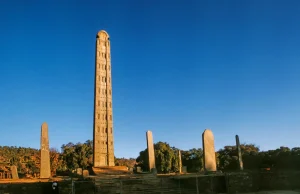
The city’s monumental architecture reflected its wealth.
The great stone stelae are perhaps the most famous remains. Some were carved to resemble multi-storey buildings, complete with symbolic architectural details. The largest surviving standing example rises more than 23 meters, while another enormous monolithic stele lies broken where it fell.
But the stones tell only part of the story.
Aksumite rulers also issued coins, built monumental structures and used Ge’ez in written inscriptions. Some inscriptions were multilingual, combining Greek, Sabaean and Ge’ez and providing historians with valuable evidence about the kingdom and its rulers.
Then came one of the most significant transformations in Aksum’s history. Christianity reached the kingdom in the 4th century.
The new religion eventually became deeply embedded in the political and cultural identity of the region, and churches began appearing alongside the older monuments. Aksum therefore became not only a commercial and political center but also an important religious one.
Yet powerful cities can lose their advantages.
Over time, political and commercial circumstances changed. Aksum’s dominance declined, and by around the 10th century its political importance had significantly diminished. Even then, however, the city did not become irrelevant. Ethiopian rulers continued to associate themselves with Aksum, and emperors were still crowned there centuries after the ancient kingdom’s political decline.
That makes Aksum different from a city that vanished completely. Its ancient political world faded, but its identity survived. The ruins therefore sit alongside a living cultural and religious landscape, creating a remarkable connection between ancient Africa and the present.
Loropeni: The Fortress Whose Story Is Still Incomplete
Not every one of Africa’s lost cities gives historians neat answers. Some leave behind more questions than certainty. Loropeni, in southwestern Burkina Faso, is one of them.
The first impression is striking: massive laterite walls, some reaching up to six meters high, enclosing the remains of a settlement. They rise from the surrounding landscape with an almost fortress-like appearance, making it difficult to believe that the site remained largely unknown outside the region for so long.
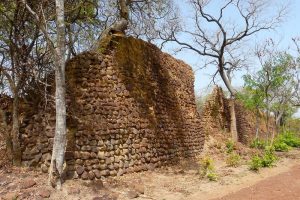
Loropeni forms part of a much larger network of stone built enclosures in the region.
Archaeological research suggests that the walled settlement dates back at least to the 11th century and flourished particularly between the 14th and 17th centuries. It was connected to communities involved in the extraction and transformation of gold at a time when trans-Saharan trade was becoming enormously important.
Gold changes the way we understand the walls. A fortified settlement in this location was not simply an isolated stronghold. It existed within a landscape shaped by one of the most valuable commodities in the medieval African economy.
Gold from West Africa travelled north across the Sahara and entered markets far beyond the region. The wealth associated with that trade helped shape political power, settlements and long-distance connections. Yet Loropeni refuses to reveal everything.
Large parts of the site remain unexcavated. Archaeologists know that the settlement experienced periods of abandonment, but many questions about its people, organization and precise function remain open. UNESCO notes that the site was finally deserted in the early 19th century.
That uncertainty is not a weakness. It is part of what makes the ruins compelling. Unlike a monument whose history can be reconstructed from extensive written records, Loropeni asks visitors to look at the stones and imagine the society behind them.
Who lived inside the walls? How did the settlement change as gold production changed? What did its markets look like? What happened to the people when they eventually left? There are still discoveries to be made. And that makes Loropeni feel less like a finished chapter and more like a story still being written.
Khami: What Happened After Great Zimbabwe?
Sometimes the story of a lost city only makes sense when you find the city that came after it. Khami, near present day Bulawayo in Zimbabwe, is one such place.
When Great Zimbabwe’s political dominance faded, the story of monumental stone-building in southern Africa did not end. Instead, political power shifted and the Torwa dynasty established its capital at Khami. The city developed after the abandonment of Great Zimbabwe and remained an important center between roughly 1450 and 1650.
Khami inherited aspects of the architectural tradition associated with Great Zimbabwe, but its builders developed their own distinctive style.
The settlement was organized around a series of elevated platforms and dry-stone structures. Walls were carefully decorated with chevron and chequered patterns, while elaborate retaining walls helped shape the settlement’s terraces. The result was not simply a defensive fortress. It was an organized urban environment.
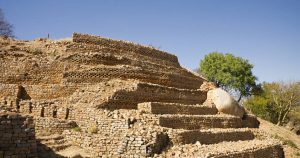
The chief’s residence stood on the Hill Ruin, while surrounding areas contained dwellings, cultivation terraces and other structures. UNESCO describes Khami as the second largest stone-built monument in Zimbabwe and an important link between the history of Great Zimbabwe and the later Zimbabwean states.
And once again, trade appears in the archaeological evidence. Objects from Europe and China have been discovered at Khami, including Spanish porcelain, Rhineland stoneware and Ming porcelain. Such finds reveal that the city remained connected to long-distance trade despite being located far from the ocean. That is one of the most interesting patterns among Africa’s lost cities.
Distance did not necessarily mean isolation. Trade routes could carry objects, ideas and wealth across enormous distances, linking inland cities to coastal ports and foreign markets.
Khami eventually met its own end. The settlement was abandoned during Ndebele incursions in the 19th century, bringing another chapter of the region’s stone-building tradition to a close.
Today, its walls remain. But the importance of Khami goes beyond the ruins themselves. It helps us understand that Great Zimbabwe was not a solitary achievement. It belonged to a longer architectural and political tradition in which cities rose, declined and were replaced by new centers.
One city did not end the story. It handed the story to another.
Timbuktu: The City That Turned the Sahara Into a Crossroads
There are few African place names that have become as legendary as Timbuktu. For centuries, the word itself suggested somewhere impossibly distant. Yet the real Timbuktu was not a mythical city at the edge of nowhere. It was a major center of commerce, scholarship and religion.
Founded around the 5th century, Timbuktu reached its greatest economic and cultural influence during the 15th and 16th centuries. Its location near the southern edge of the Sahara placed it in an ideal position between the desert trading routes to the north and the fertile regions farther south.
Goods flowed through the city. Salt came from the north. Gold moved northwards from West Africa. Cattle and grain arrived from the south. Manuscripts were traded. Merchants came and went. But Timbuktu’s greatest legacy was not simply its wealth. It was knowledge.
The city became a major center of Islamic learning, with the famous Sankore institution and numerous Quranic schools. UNESCO records that Timbuktu had around 180 Quranic schools and approximately 25,000 students during its intellectual golden age.
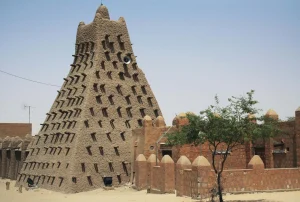
Imagine the city at that time. Students studying religious texts. Scholars debating ideas. Merchants negotiating in markets. Caravans arriving from across the Sahara. Manuscripts being copied, bought and transported.
The great mosques of Timbuktu; Djingareyber, Sankore and Sidi Yahia, were not simply places of worship. They became symbols of a city where religion, commerce and scholarship were deeply intertwined.
Its wealth and influence eventually declined as political power and trade patterns shifted. But Timbuktu’s history did not end with its golden age.
In 2012, the city suffered a devastating attack on its cultural heritage. Armed groups destroyed historic mausoleums and damaged other monuments, while thousands of manuscripts were destroyed or taken away. The destruction shocked the world precisely because these were not simply old buildings. They were physical evidence of an intellectual tradition that had shaped West Africa for centuries.
Restoration followed. Historic structures were rebuilt using traditional techniques, and efforts to preserve the manuscripts continued. That makes Timbuktu an important reminder that a lost city does not always have to be completely abandoned to become endangered.
Sometimes a city can remain alive while the world it once represented slowly disappears around it.
Timbuktu’s old streets, mosques and manuscripts continue to carry the memory of a time when the Sahara was not a barrier separating societies. It was the route that connected them.
Sabratha: The Mediterranean City Built From Africa’s Interior
The final city on this journey lies in a landscape that may seem completely different from Great Zimbabwe, Meroe or Kilwa. Sabratha stands on the Mediterranean coast of present day Libya. Its ruins include temples, public buildings and a spectacular ancient theatre, but the city’s origins go back much further than its Roman monuments suggest.
Sabratha began as a Phoenician trading post, serving as an outlet for products from the African interior. It later became part of the short-lived Numidian Kingdom of Massinissa before being absorbed into the Roman world and rebuilt extensively during the 2nd and 3rd centuries AD.
That sequence alone reveals how complicated the history of African cities can be. Sabratha was not simply a “Roman city in Africa.” It was a place where different political and cultural worlds accumulated over centuries.
The Phoenicians recognized the value of its coastal position. Later rulers inherited that advantage. Under Roman rule, the city developed into a monumental urban center with impressive public architecture.
The theatre is its most recognizable structure. Its elaborate stage architecture still rises dramatically against the surrounding ruins, offering a sense of the scale of public entertainment in the ancient city. The theatre could accommodate thousands of spectators, while temples and other buildings reflected the wealth of Sabratha during its most prosperous period. Yet the city’s importance was ultimately tied to something much less glamorous than architecture, trade.
Goods from the African hinterland moved towards the Mediterranean through cities such as Sabratha. Its prosperity depended on its position within wider economic networks, just as Kilwa depended on the Indian Ocean and Timbuktu depended on the trans-Saharan routes. When those systems changed, cities felt the consequences.
Sabratha’s decline came gradually through a combination of political and economic changes that affected the ancient Mediterranean world.
Eventually, the bustling city became an archaeological site. Its theatre remained. Its columns remained. Its temples remained. But the people who had filled its streets were gone.
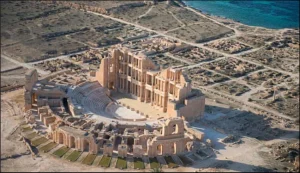
Today, the ruins provide an extraordinary record of the different worlds that once met along the North African coast. Sabratha’s story also adds an important dimension to the idea of Africa’s lost cities: some were connected primarily to inland African kingdoms, while others stood at the meeting point between Africa and the Mediterranean. Either way, their fortunes depended on connection.
Why Did These Cities Disappear?
Looking at these eight cities together, one thing becomes clear: there was never a single reason why an African city was lost.
Cities are rarely destroyed by one event and then simply forgotten. More often, decline happens slowly. A trade route moves. A political dynasty loses power. A river or climate pattern changes. The surrounding land struggles to support a growing population. A new kingdom takes control. Foreign intervention disrupts an established economy. People begin leaving, perhaps gradually enough that nobody living there realizes they are witnessing the end of a city.
Great Zimbabwe’s decline was associated with pressures on its surrounding resources and food supply. Kilwa lost much of its commercial dominance after Portuguese intervention disrupted the trading system on which its prosperity depended. Timbuktu’s importance changed as political and commercial circumstances shifted. Khami was eventually abandoned amid later political upheaval. In other cases, such as Loropeni, archaeologists are still piecing together the reasons behind periods of abandonment.
That is why the word “lost” can be misleading. These cities did not necessarily disappear overnight. Their decline may have taken generations. People may have carried their traditions elsewhere. Craftspeople may have continued their skills in new settlements. Religious practices may have survived. Political institutions may have been transformed rather than completely destroyed.
The city disappeared. The people did not necessarily disappear with it. That distinction matters because ruins can make history look more final than it really was. A wall remains in one place, but the society that built it may have continued somewhere else.
What Africa’s Lost Cities Reveal About the Continent
Perhaps the most powerful thing about these ruins is how much they challenge the idea of Africa as a continent whose history began with the arrival of modern European powers.
Long before colonial borders existed, African societies were building cities, controlling trade routes, producing metals, developing writing systems, creating monumental architecture and establishing connections that stretched across deserts and oceans.
Great Zimbabwe’s gold trade connected the southern African interior with the Indian Ocean world. Kilwa turned the East African coast into one of the most important commercial regions of the medieval Indian Ocean. Meroe developed as the center of the Kingdom of Kush, a state powerful enough to rule Egypt for a period and maintain its own cultural traditions for centuries. Aksum stood at the intersection of Africa, Arabia and the Greco-Roman world. Timbuktu became a center of scholarship whose influence extended across West Africa. Loropeni reveals how gold shaped settlements far into the interior of West Africa. Khami demonstrates that monumental stone-building traditions continued long after Great Zimbabwe declined. Sabratha shows how the Mediterranean coast was deeply integrated into the economic and political worlds of ancient Africa.
These were not isolated achievements. They were parts of interconnected histories. And perhaps that is why Africa’s lost cities are so valuable to travellers today.
A safari can introduce you to Africa through its wildlife. A journey along the coast can reveal its beaches and islands. A mountain trek can show you its landscapes from a completely different perspective. But ancient cities offer another way to see the continent.
They allow you to walk through the remains of societies that existed hundreds or thousands of years ago and ask questions that have no easy answers. Who lived here? What did they believe? What did they trade? What did their homes look like? What did their cities sound like when they were full of people? And perhaps the most haunting question of all: what did the final generation know about the fact that their city was slowly disappearing?
The Ruins Are Not the End of the Story
There is a temptation when visiting an ancient ruin to think of it as the remains of something that is finished. But Africa’s lost cities are not finished stories.
Archaeologists continue to excavate them. New evidence changes old interpretations. Buried structures reveal how cities were organized. Ceramics reveal trade routes. Coins reveal economic connections. Written inscriptions reveal rulers and beliefs. Even small fragments of ordinary household objects can reveal how people lived.
At Loropeni, much remains to be excavated. At Kilwa, large parts of the ancient urban landscape remain beneath the ground. At Aksum, modern buildings overlap parts of the ancient city, meaning that the archaeological landscape is far from fully understood. UNESCO notes that much of the underground Aksumite structure remains obscured.
The discoveries therefore have not stopped. There are still stories beneath the soil.
That is what makes travelling to these places so different from simply looking at photographs of ancient monuments. When you stand beside a centuries-old wall, you are looking at something that survived the collapse of the world that created it.
The city may be gone. The people may be gone. The markets may be silent. But the stones remain as witnesses. And perhaps that is the real power of Africa’s lost cities. They remind us that civilizations are not measured only by what survives. Sometimes, what survives in fragments is enough to reveal just how extraordinary the lost world once was.
For travellers willing to look beyond the familiar routes, these ruins offer another Africa to discover, one of ancient kingdoms, forgotten capitals, international trade, scholarship and extraordinary human ingenuity.
The wild has reclaimed many of these places. But it has never completely hidden their stories.
You can explore more UNESCO World Heritage Sites in our guide to The Best UNESCO World Heritage Sites in Africa.