There is so much more to explore and experience than just Maasai Mara – the famous safari spot and Tsavo with its huge elephants and zebras, as well as India- like beaches along the Kenyan coast – all making Kenya one of the top tourist destinations globally. If you are looking for more than the ordinary, off the beaten track places to visit then there is more to Kenya than just meets the eye and that more is hidden in its Western part, simply described as the country’s best kept secret and by far one of the most breathtaking destinations in all of East Africa.
The Hidden gems in western Kenya is a region of great cultural and geographical diversity, holding up a mirror to Africa. The awesome mass of Lake Victoria, the country’s only tropical rainforest, the beautiful rolling hills of tea country, stretching up to the highlands, are just a few of the many aspects that make up this phenomenal landscape of great warmth and hospitality of local folk.
A trip to Western Kenya is a deep journey into the many facets of this wonderful country. The region has some of the most beautiful island paradises on the largest lake in Africa and wonderful dense rainforest, teeming with hundreds of species of trees, including some of the rarest species in the world. Historical remains of 16th century dry-stone buildings and sites can be found and two unique wildlife sanctuaries are home to rare species of wild life. This guide will be a basic practical guide to this wonderful part of Africa.
Unlike most vacation experiences offered to Hidden gems in western Kenya Region is a more peaceful and environmental setting for such tourists. A visitor to Western Kenya Region has a unique, intimate and memorable experience or encounter with as much as he/she cares to experience and learn. If you are an adventurous traveler, an Eco-tourist or a culture aficionado, then leave the crowds of tourists behind to experience the natural unadulterated beauty of Western Kenya.
II. The Lay of the Land: Geographical and Cultural Context
On the face of it Hidden gems in western Kenya is not big as compared to other regions of the country. However, the natural landscapes vary so much that one would actually think that they are in different parts of the country. To someone who has not been there before, the main attraction is when you roll down to the west where a huge basin of Lake Victoria covers the entire region in the form of plainlands that touch the sea level of the lake.
As you head north-east, the area rises to the highlands where you’ll find some of the most beautiful, productive and famous tea growing areas of the world. The rolling hills of tea are endless and go all the way to the eye’s horizon. To the north, your eyes will follow the existing high peaks of Mount Elgon, a dormant volcano that actually extends to part of Uganda.
Honesty, the most striking aspect of a road less travelled like the A109 from Kisumu to Kimilili are the rich cultural clusters of the people who know and call the area home. Western Kenya is home to three main ethnic groups; each with deep rooted traditions and ways of life that are yet to be exploited by tourism.
While the majority of the population who live on the shores of Lake Victoria are Luo, the heartland of the agricultural rich region is home to the many sub-tribes of the Luhya. Up in the cool highlands, it’s the Kalenjin community who call this area home – and with them, the world’s greatest long distance racers.
The Kuria people who live on the border with Tanzania with the rest of their tribe in Tanzania add the fourth strand to this tapestry of tribes. But it’s the one outstanding thing about all of these incredible communities that stands out; that is their stunning warm hospitality that is delivered genuinely and personally, without the transactional feel that often invades the world’s most travelled tourist trails.
To start with it is always helpful to get a sense of a country’s geography and climate and how these may vary from place to place. Much of Kenya is on the Equator and Western Kenya is at a reasonable height. The area around Lake Victoria is always very humid and experiences a ‘tropical year’ – that is to say that the seasons are reversed from those in the temperate world. The highland areas such as Mount Elgon and the Kakamega area are cool and perfect for hiking, game viewing and for exploring the many ancient and medieval ruins that can be found in this region.
For most of the year Hidden gems in western Kenya experiences two wet seasons – the long rains from late March to May and the short rains from late October to late November. The two dry seasons are from December to February and from June to September and these are the best times to visit this region. Birdwatchers may find the wet and cool months of the year to be too much but also the most spectacular time of year when the forests are at their best and the whole landscape is one of rioting green and new growth.
III. The Crown Jewel: Lake Victoria & Its Surrounds
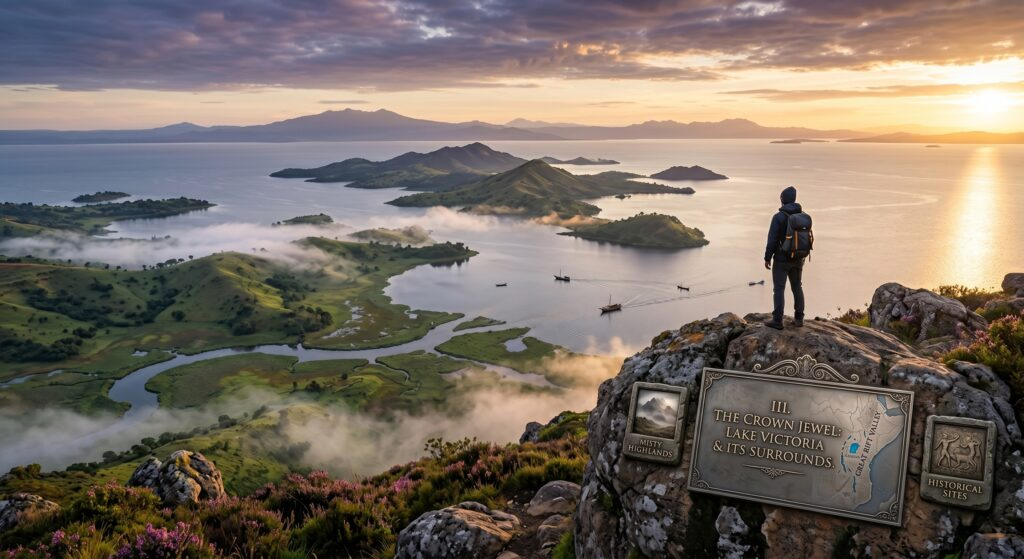
Western Kenya, or more specifically Lake Victoria, is a must visit destination for any traveler. Locals refer to it as Nam Lolwe. This is the world’s largest Lake, and the source of the Nile River (the world’s largest river), covering an area of 60,000 square kilometers. Its vast waters support life, both human and marine.
Kisumu town is the main entry point to the lake. It is the number one tourism and cultural hub of Western Kenya, even more chaotic than Nairobi, but at a much slower and peaceful pace. Dunga beach is only a few minutes from town.
This is just a beautiful place to just chill and relax on raised wooden shade watching through a packed papyrus swamp. Dunga is also home to the fishing culture of the locals where they use wooden canoes painted in vibrant colours to search for their daily bread of big Tilapia and Nile Perch. Guests can also have experience of amazing sunsets in Africa.
We also have an impala pack which is based just within the city of Kisumu in the smallest of Kenya’s national parks. The impala herd roams freely on the lake side and there is also the opportunity to see huge hippos, various birdlife and some of the rescued big cats.
This museum is great as it gives one a great experience from the natural and cultural side focusing on the early times of the traditional Luo homestead and the modern days.
We just do a short boat to arrive at the Ndere Island Park where you can go for a guided walking safari. There are huge Nile monitor lizards, lots of crocodiles basking in the sun on the rocks as well as impalas grazing within reach as you trek through the tall grass searching for other wildlife.
Further south lies another haven of serenity with the capped ridges and ‘islands’ that project onto the lake’s shores. Rusinga Island – literally a stone throw from the mainland- offers unparalleled luxury and historical heritage in a place where archaeology is at its purest form; this is where Mary Leaky found a skull of proconsul africanus – about 18 million years old.
The Island is home to the Tom mboya mausoleum, a memorial to one of the prominent fathers of Kenya’s history. Rusinga is home to luxury eco-lodges that offer world class sport fishing demos and retreats in the middle of the great African wilderness.
As you drive further you get to reach Mfangano island, a more rugged land mass with giant fig trees and no cars can cross over here. The caves have the Hidden gems in western Kenya greatest treasure e greenlands and the largest grasslands to finish the densely populated Koitobos Peak is the most amazing exploration. The base of Mount Elgon houses the largest lava cave tubes and the most famous Kitum cave. Inside these deep holes of darkness, one would least expect to find herds of elephants roaming around feeding on the mineral salt rocks they have created inside the top of Mfangano island.
You will also get to see ancient red and white painted rock art by the hunters and gatherers [Batwa] who used to inhabit the place and left their mark thousand years ago. It will be a unique visit to Mfangano Island, serene fishing villages where life has not changed for generations.
The last of the impressive places to visit is the Takawiri islands in Mbita constituency. The islands add the last piece to the complete journey experience on Lake Victoria. Viewing the beautiful Takawiri islands leaves the tourists shocked. The white sandy beaches full of entwined palm trees make you imagine and feel as though you are in the coastal part of Kenya by the ocean. But here you will find fresh unsalted water, a perfect breeze that awaits as you swim or windsurf and offers the ultimate experience to these magnificent wonders of Lake Victoria.
IV. Pristine Forests & Unique Wildlife Reserves
For an alternative perspective on safari, clients can opt to travel to the landscapes on the shores of Lake Victoria’s Moving Islands. Through papyrus swamps and rolling savannas, they can visit dense tropical rainforest and a series of specialist wildlife reserves. These compact reserves are dedicated to the conservation and protection of East Africa’s rarest and most beautiful species and offer an entirely different safari experience to that found on the endless plains of the Mara.
Kakamega Forest National Reserve is the green space of Kakamega. You will be visiting Kakamega, the prehistoric world of fig trees, Elgon teak trees and more. The great guineo-congolian tropical rainforest that covers a huge part of central africa is of immense ecological and archeological significance in Kenya. The passionate primate enthusiasts will instantly recognise the rare De Brazza’s monkey from the orange crown and white beard as well as the black-and-white monkeys playing and feeding underneath the giant fig trees.
The forest also houses over 300 bird species and over 400 butterfly species such as the Great Blue Turaco and many more chapping birds which will guide you through the very hidden paths giving you unforgettable and memorable experiences.
Standing in over 140 square km, Ruma National Park spans across the countryside of Homa Bay county offering tourists a thrilling opportunity for safari adventures and wildlife viewing, the Park contains the country’s only remaining members of the most endangered Roan Antelope species, a truly spectacular creature to see with striking markings around the face and scimitar-shaped horns that rise strangely from her tall grass habitat.
Ruma also is home to Africa’s tallest mammal, the long-necked giraffe, leopard, the fast-moving oribi antelopes, the endangered eastern black rhinos, and a host of forest reserves of woodland and golden savanna habitats. The entire National Park can be freely accessed and explored in style and luxury.
Situated within the Tansozoia region of Kitale in Kenya’s Rift Valley, the Saiwa Swamp National Park is the smallest of Kenya’s national parks covering only three square kilometers. However, what it may lack in terms of size is well compensated for in terms of the diversity and unique nature of its vast array of wildlife – particularly the stunning Sitatunga. This incredible creature is able to walk on the floating vegetation in the swampy areas with ease, thanks to its long splayed hooves and water adapted body.
Even when it is frightened, it can instantly dive beneath the surface of the water with the exception of its nostril breaching the surface. Aboard long, elongated boardwalks made of wood that stretch through the dense tropical wetlands, visitors can venture into the park as cars are unable to tour here due to the sensitive ecosystem.
Standing high above the ground, visitors are not only able to soak in the surreal ambiance of the swamp but can also get up close to one of the swamp’s premier residents, like the Sitatunga slowly making its way through the tangled mass of branches and vegetation directly above visitors. In Saiwa Swamp National Park, visitors can experience true west kenya wilderness magic silently hiding in plain sight.
V. Mystical Mountains & Highland Landscapes
Right after the wetlands follow the wetlands forests. Shortly afterwards the landscape turns into the Western Kenya elevation and reaches its highest point in some of the least visited yet most spectacular areas for East Africa trekking for hikers and nature lovers alike.
To the north of Uganda the boundary with Kenya runs through Mount Elgon National Park. Elgon is the largest volcano in the world by base area with a huge 4,300 sq km crater basin and offers unique open mountain walking, in contrast to the forests and rugged upland of the higher peaks of Mount Kilimanjaro and Mount Kenya that attract more trekkers. The experience is insane and unforgettable as you trek through misty alpine forests, rock gardens and vast caverns, including some of Uganda’s biggest black caves.
To the east of Mount Elgon, there are the Cheranganyi Hills, a different highland experience. The massif of Cheranganyi is one of the five great mountain massifs in Kenya, comprising forested ridges, dramatic escarpments and beautiful landscapes.
The area is open and not as controlled as in National Parks, offering a unique combination of Nature and Culture. For centuries, the Cheranganyi have been the ancestral home of the hunters and gatherers known as the ‘Sangwe people’. In these rapidly changing times, as modernization takes over, it is wonderful to be able to visit this ancient community and experience for ourselves their simple way of life and learn about their history and traditions.
As we continue with our travels through west kenya we have to go to the moorlands of the Kericho in the Nandi hills. We had a fantastic time trekking down through the rugged hills and the montane forest with spectacular views of the rolling hills and evergreen tea plantations stretching as far as the eye can see. This is the highest concentration of tea production in the world and is said to be the best black tea in the world.
We found it was great to be able to visit this area as opposed to a closed off national park and experience how tea is farmed, picked and then served in your glass. It was a great way to spend a morning, trekking through the moorlands to experience a serene morning in the highlands with nothing but peace and quite to listen to, and to see the morning sun rise up over the landscape, casting a bright glow over the lush and green tea leaves.
VI. Rich Heritage, Myths, & Historical Sites
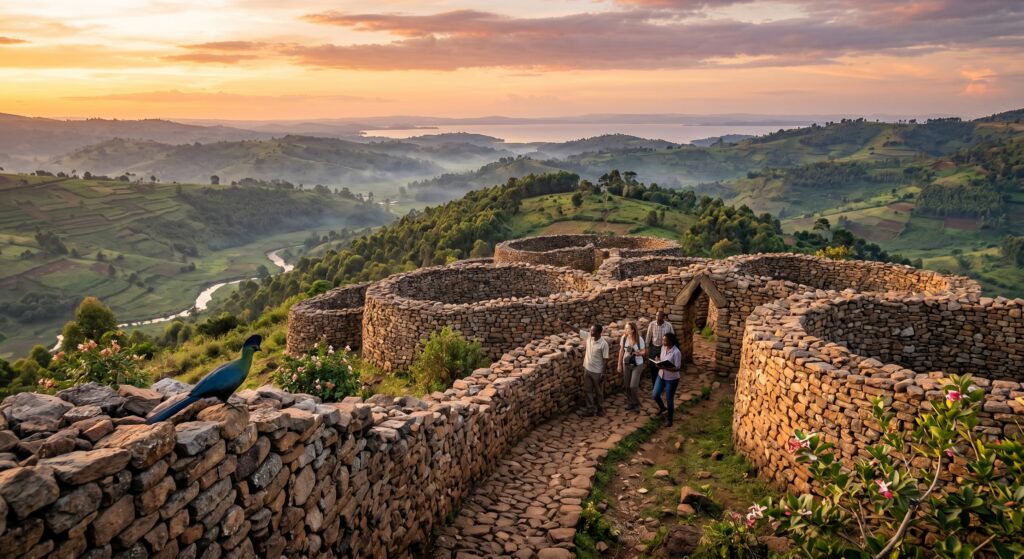
Hidden gems in western Kenya has a rich history that many still connect with because it is part of what shaped its people. The evidence of that history is imprinted in what many would call mere stones on a dry landscape. Thimlich Ohinga Archaeological Site in the heart of Migori County is precisely that historic site renowned world wide as a UNESCO world heritage site. The site consists of a complex of dry stone walls dating back to the 16th century, impressively constructed without mortar.
The architecture is precise and is believed to have served a vital function of giving man ancient protection to him and his livestock. As you meander through the numerous cattle kraans and homes of the long lost herders you get to connect to the ancient pastoralist societies that roamed the shores of Lake Victoria.
Western Kenya is home to a wealth of historic sites that feature important geological and archeological exhibits. One of the more impressive geological features is Kit Mikayi, a 70-foot tall rock known locally as “The Stone of the First Wife” (Mikayi in Luo means first born female). The rock stands alone in the center of flat plains, a towering mass of granite that somehow manages to remain upright.
The rock is believed by local people to represent the traditional polygamous way of life and the tallest rock is said to be “Mikayi” weeping after her husband brought home another wife. According to local lore Mikayi went to the rock and wept. The rock is more than a simple geological exhibit or local legend. Many Legio maria followers go to pray and fast under the rock in order to receive spiritual healing.
Another myth and theology is being discovered by researchers in Kakamega county, a crying stone of Ilesi. It is 40 meters high and has a large balanced natural formation on top of the rock. The Luhya community refers to it as a crying stone because it weeps in natural form with a stream on it dispensing water downwards. To geologists it is a spring of water connected to rock in the local community.
When the stone is crying it symbolizes a suspicious sign whether it is of good harvest or a warning. The site therefore gives us a clue of how much traditional myths and beliefs are inextricably linked to the landscape.
Kogelo village in Siaya county is an ancestral home of the Late Barack Obama Sr the father of the 44th president of the United States of America. The site is globally historical hence very many people visit daily. Tourists also visit and see the senator barrack sr secondary school and the grave of Obama Sr. This is one place with deep worldwide connections, from an often unpopular area in Western Kenya.
VII. Immersive Activities & Adventures
Visiting the Hidden gems in western Kenya will need more of an energetic and focused mind in appreciating the various landscapes and historical sites; more so, it’s an active way of tourist involvement in various activities related to its culture and Tourism and Travel areas.
For most visitors the adventure starts from Lake Victoria; a world class destination for spot fishing and water sports. Tourists from all corners of the globe fly to the Victoria basin to participate in various activities. Deep water battles with the mighty Nile perch which can weigh over 100 kilograms is an unforgettable experience. Traditionally dhow and wooden boat rides are another activity on offer.
Cruising peacefully across the glass-like surface of the lake at dawn or dusk hearing the calls and the splash of fishermen submerging into the waters in their fish nets to haul in their catch gives you a wonderful experience of connecting with the local culture.
Hidden gems in western Kenya is clearly the hotspot for new collections for the ornithology passionate enthusiast. As the ecological bridge linking the African tropical rainforest of Central Africa to the East Africa Savannas, the avian diversity is absolutely unmatched anywhere else in the country (including Mara and Tsavo). The 300 plus species that can be seen in Kakamega Forest alone (e.g. Great Blue Turaco, Turner’s, to name a couple of favorites) make this area just paradise for any serious bird enthusiast.
The shores of Lake Victoria hold an equally impressive collection of species along the lakeshore including swamp flycatchers, African fish eagle and fascinating Papyrus Gonolek. In the papyrus fringed swamps of the lake basin one is serenaded by their haunting cries.
Culinary tourism is an area that can be experienced in the culture of Western Kenya. All the food we have tasted and are fresh. They derive from agriculture of Western Kenya. And in Western Kenya fresh fish is king when it comes to culinary tourism. The food that is eaten includes deep fried Tilapia served with tomato and onion gravy. And then there is Omena, which are very small fish with a lot of nutrients. They are traditionally sun dried and can be made into very delicious tasty stews. In Hidden gems in western Kenya you will get the best seafood anywhere.
Here we have two rich and nutritious proteins of fish and meat paired with Kenya’s staple food Ugali which is made of maize and has lots of starch. This stiff food is very satisfying. The generous helpings of creamed traditional green vegetables of choice such as Osuga(African Nightshade) and Dek(Spider Plant) complete this bounty.
Up in the highlands we encounter the Kalenjin folk and a true test of mursik,a heritage of the herders. The mursik here is first fermented in a special shaped calabash and then enjoyed with charcoal made from special trees of the region. It is so fulfilling and delicious. These dishes offer a true window into the heart and soul of the Western Kenya region. .
VIII. Practical Travel Guide for Western Kenya
As Africa’s less traveled part, Western Kenyas hidden tourist gems is still by no means difficult to visit as long as some planning is done. When people say that the less-touristy areas of Western Kenya are out of reach for travelers who need to organize everything in advance, they are mistaken. In reality, all sorts of travel to this corner of Africa is easily arranged and even organized on the go.
Getting There: By air the main ports of entry are served by a number of daily flights from Nairobi (Wilson airport) to the domestic terminals at Kisumu International Airport and Eldoret International Airport.
If preferred, the well-maintained main road from Nairobi (the floor of the Great Rift Valley) can be covered in six to eight hours depending upon traffic conditions. In 2006 the Ugandan railways were revived and a new link made with the Tanzania section. It is now possible to take the train all the way from Nairobi to Kisumu.
Traveling between destinations is quite straightforward as well. If you plan on hiking in the higher reaches of Mount Elgon, going on a trekking or camping tour in Ruma National Park or exploring the Cherangani Hills by foot, you will need to hire a 4×4 for traveling around.
However for touring the many Western Kenyas hidden tourist gemsby car, matatus (minivans) are a cheap and Kenyan way of traveling that tourists use as well. As they say in Kenya, ‘there’s always another one coming along’ and they will travel to almost everywhere. For short journeys around towns or even between a hotel and a restaurant on the lake shore of a town, boda bodas (moped taxis) are an extremely cheap and quick way to get from A to B. Remember to always wear a helmet though.
Western Kenya has an array of accommodations to suit just about any budget. The region boasts of the higher end island resorts found on Rusinga and Ng’oma Islands in Lake Victoria. The island resorts offer a range of accommodations to suit different travelers such as the lodge rooms and the eco-camps found on the two Islands. While on business or just visiting Kisumu City in Western Kenya, you will find a wide range of accommodations ranging from the simple heritage properties and the eco-camps and then the more modern decent mid-range business hotels.
IX. Conclusion
The region of Western Kenya also represents another side of what most people believe to be Uganda and the rest of East Africa. Although of relatively small size, Hidden gems in western Kenya boasts an array of landscapes including sparkling lakes, awesome wildlife, cool mountainous countryside with mist-shrouded valleys and even remnants of Africa’s original primeval forests.
is also great diversity in terms of things to see and do here, all largely ‘off the beaten track’ meaning that virtually all locations are avoided by the bulk of typical safari visitors; thus travelers have the option of experiencing their preferred type of holiday in a country so very different to their normal vacation, with beautiful land and stunning scenes of such natural beauty that they are in fact indescribable by even the best of photographs.
A trip to this part of the country will afford most visitors the definitive image of ‘Uganda’ and be a truly unforgettable experience which will no doubt remain with anyone who travels to this extraordinary area for a very long time.