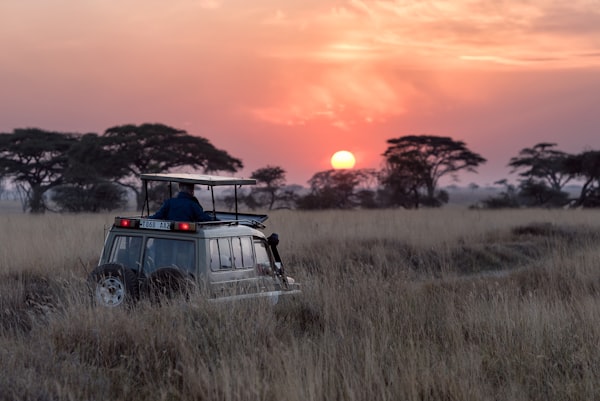
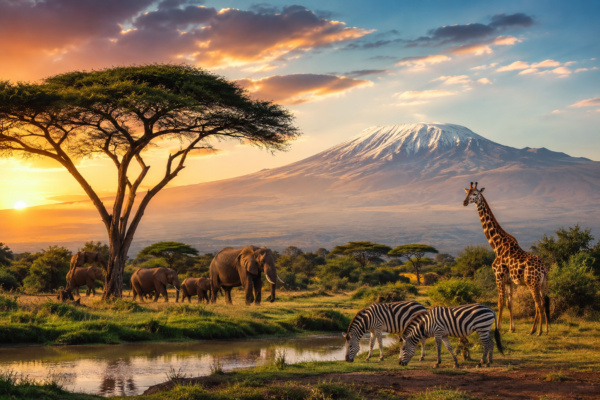
There is little more beautiful than the dawn breaking in Africa. Rolling hills grow green and broad into seemingly endless plains, punctuated here and there by a single flat-topped acacia standing silhouetted against the golden light.
The only sound in the morning hush is the low grumble of a lion’s growl in the distance, interspersed with the hooves of hundreds of thousands of wildebeest feasting across the savannah under an endlessly blue sky. Masai Mara safari guide 2026 it is truly the crown jewel of Kenya.
The Masai Mara National Reserve is one of the world’s greatest wildlife reserves covering an area of 1,500 square kilometres in the heart of Africa, specifically in the southwestern part of Kenya. It is the northern extension of the Serengeti National Park in Tanzania and is one of the oldest and most spectacular wildlife reserves on the face of the earth.
The reserve is also the people’s place – the ancestral homeland of the Maasai. Africa’s greatest wildlife reserve is also home to incredible wealth of traditional African culture.
You can encounter Maasai throughout the Mara dressed in traditional regalia. The Mara is world famous for viewing all species of big cats, specifically lions, leopards and cheetahs, and many visitors comment on the unique opportunity to see all three species on a single safari.
For many, a Masai Mara Safari is the pinnacle of adventure and a ‘once in a lifetime’ dream trip. But turning that dream into reality is not without its pitfalls, particularly if not planned well.
While temperatures are expected to remain high across the Masai Mara during summer, it is likely to be slightly wetter than usual, adding an extra element into the equation for guests planning a safari trip this year.
Furthermore, it is often quite tricky to predict the true costs of a safari holiday and with rules and regulations within African national parks frequently changing, latest information on 2026 park fees for the Masai Mara must also be up to date. If all of this is not correctly planned, your trip of a lifetime could turn into one disaster after another.
If you’re wondering how much a Mara tour will cost, the answer is here, as are responses to other frequently asked questions.
You may wonder what the best month to visit the Mara is, or you may be wondering what the new 12 hour park rule means.
We have covered everything you need to know about touring the Mara in this definitive guide to help you get the most out of your once in a lifetime Kenyan safari experience.
II. Why is Masai Mara So Famous?
The Mara gets bad press for having been “marketing’s” but it is hard to think of another place on earth as ecologically diverse, beautiful and rich with wildlife.
The Mara is often referred to as the “World Cup of Wildlife” because of the incredible density of animals that call the area home.
The Great Migration: Nature’s Greatest Stage
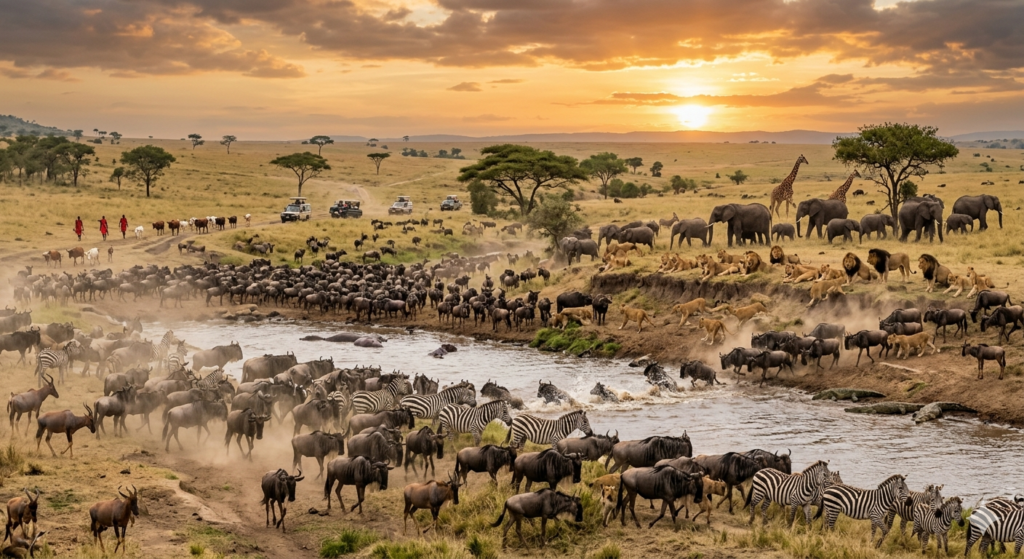
The global status of the Mara as a tourism destination is founded largely on the fame of the Great Migration. Every year during the months of July, August, September and October over 1.5 million wildebeest are joined by 200,000 plus zebras and hundreds of thousands of Thompson’s gazelles all trekking north from the Serengeti to the Mara in search of grazing.
The ultimate spectacle that draws the world’s tourists is the actual crossing of the Mara River, where hundreds and thousands of individuals congregate to test their will against the swirling torrent in a desperate bid to reach pasture.
Herds hesitate on the sharp banks before making the leap into the crocodile filled waters, where life or death is determined in an instant, a primal moment that draws huge audiences and numerous researchers every year.
The Capital of Big Cats
Although the migration is seasonal, the Mara’s big cats are resident all year round, with one of the highest concentrations of lions, leopards and cheetahs in Africa.
The grass plains of the Mara Reserve were the main filming location for the BBC’s well-loved Big Cat Diary, bringing the Marsh Pride lions and other cats such as Bella the leopard into our living rooms all over the world.
Due to the open savannah terrain, sightings are regular but the wildlife’s behaviour can be spectacular. Watch as a cheetah stalks its prey at top speed or a lion pride defends their turf from invading hyenas.
The Quintessential African Aesthetic
The Mara matches the typical public imagination of Africa. The name Mara means “spotted” in Maa, it refers to the dotted appearance of Acacia trees and cloud banks on the rolling, endless sea of yellow grass.
This is Big Sky Country and some of the worlds greatest wildlife photography is produced here due in large part to the enormous skies and long lines of sight.For many, Africa is a cinematic holiday experience.
The solitary silhouette of an elephant against a fiery sunset or the gentle tendrils of river mist at dawn crowning the towes of trees along the Mara River are images familiar to many safari-goers and not easily forgotten.
The Cultural Guardians: The Maasai People
The most important inhabitants of the Mara, however, are its people. The Masai are one of the few tribes in Africa who have managed to keep their age-old, semi-nomadic pastoral way of life.
Their distinctive appearance in red shukas and beaded jewellery makes them a familiar sight in the Mara, as they go about their centuries old way of coexisting with the wildlife.
The Mara today is a powerful model of community-based conservation, where local land owners manage the vast trails of land that surround the Reserve through a growing number of conservancies.
Together they safeguard the wonderful heritage of wildlife and landscapes for future generations.
III. When to Go: Timing Your Safari
When to visit the Mara is a constant topic of discussion among tourists, because naturally enough, most wish to see the Mara at its very best; yet even in other months the area remains a very productive destination.
However, there is no getting away from the fact that conditions in the dry season months are totally different from those in the rainy season months.
The Peak Season: July to October (The Migration Window)
If seeing the Great Migration is on your mind then this is the time for you to come and experience one of the World’s greatest wonders.
The dry season has left the vegetation low and exposing vast tracts of grass, meaning that every ounce of water is sought after by the abundance of wild life and in the Mara and Talek rivers this is exactly what you will find.
- Experience the ultimate action safari as all the big game goes for the kill during the wildebeest migration season.
- Here you will witness the sensational Mara River crossings where huge crocodiles await while lions and leopards are taking advantage of the huge prey base.
- The busiest time of year to visit the park is over the school holidays with long queues, the highest park entry fees for non-residents under the 2026 regulations at $200 per day, and many of the lodges at full capacity for 12 months of the year.
The Shoulder Season: January to March (The Underrated Gem)
Although often referred to as the Short Dry Season, we consider this time of year to offer the best chance of seeing African wildlife at reasonable prices..
- While the main migration herds are in the southern part of the Serengeti, during the calving season in the Mara the resident herbivores give birth here, to the delight of visitors: zebras, giraffes, and all the Mara’s typical antelopes.
- Predator Action, the latest addition to the series, focuses on the perfect prey that are the cute newborns.
- As always you will see fierce battles between the sneaky predators and the protective big cats fighting for their young.
- Benefits: Warm and dry weather, ideal for photography, clear blue skies (unlike August!), fewer crowds in the park, and the cost of entering the park drops to $100 per day.
The Green Season: April to June & November to December
The Low Season is considered by many to be the best time to visit the Mara – during the long ‘rains’ (April-May) or the short ‘rains’ (November) the entire Landscape is transformed into an emerald Paradise.
- For the Specialists, this is one of the best times of the year to see a wide range of bird species as migrants from Europe and species from further afield such as North Africa pour through the reserves in their thousands on their way south to Africa.
- For photographers, the Green Season gives a moody sky that makes great photography and the usual dry season dust is absent, resulting in stunningly clear and vibrant greens in the images.
- The Challenges: Some roads are impassable without a skilled 4×4 driver; tall grass poses challenges for spotting smaller species of cats. Some seasonal camps may be closed temporarily for maintenance in April and May.
- The perks: Long stretches of the Mara are often left unused by other tourists. During the low season, luxury safari lodges operate at reduced rates – often as little as 50% off peak season rates for select rooms.
- Most importantly, the $100 daily fee to operate in sister parks makes luxury safari travel amazingly affordable for the budget-conscious traveler.
Overall Recommendation: Which Month is Best?
- First Timer: Go in August/September is more expensive and hectic, but worth every penny to see the Great Migration in all its glory and know what all the fuss is about.
- Photographers and Smug users with wanderlust: Come to India in February! You can enjoy all of the low season advantages (dry weather, all of the peak season big cat sightings) for the price of the low season.
- And since the weather is clearing as you head the other direction should you go earlier, February is possibly the perfect time to come. Certainly it’s less expensive and fewer 4 wheel drive vehicles on the bumpy dirt roads than in the peak season.
- For the Solitude Seeker: June or November. These periods are on the cusp of the rains and offer visitors the chance to see the lush green landscape and good numbers of resident wildlife, all without the crowds.
IV. The Wildlife: Who Shares the Savannah?
Nestled in the heart of Africa is the incredible wilderness of the Masai Mara safari guide 2026, one of the only places on Earth where you can still see a totally intact prehistoric ecosystem in action.
So teeming with life and packed full of wonderful diversity of incredible species from the tiniest dung beetle to the heaviest African elephant your Masai Mara safari will reveal a world in which each and every creature plays a vital role in an ever-changing habitat.
And as you explore the grasslands and plains on a game drive with our knowledgeable guides, it will be your eye that sees each wondrous view.
The Big Five: The Icons of the Wild
- The most desired residents for visitors are the Big Five in Masai Mara safari guide 2026 although this name was originally coined by big game hunters to describe the five animals considered most dangerous to hunt on foot, it has become more of a checklist for conservation in Africa today.
- Elephants & Hippo: There are numerous watering holes dotted around the Mara where the unlikely combo of elephants and hippo can be seen fighting for dominance – and occasionally swimming together for mating, as seen here with Elliot and Raya from Afrique Safaris
- Leopards are solitary animals that are both secretive and excellent hidlers.
- They are often found sleeping in trees, hanging upside down from branches over hanging branches, stored safely from hyenas in the branches of riverine trees with their latest kill nestled at their feet.
- Elephants: Large herds wander through marshy wetlands and wide-open plains. See these majestic animals up close as matriarchal herds make their way through the African wilderness.
- Cape Buffalo. These are the most unpredictable of the “Big 5” and are often found in large herds of formidable animals.
- Black Rhino. They are the rarest of the 4 species to see, and often are hiding in the dense thicker areas of the Mara Triangle. Seeing a Black Rhino is a true highlight of any safari.
The Great Migration Herds
While you’ll see the odd celebrities like Elephants and Lions roaming around, the plains are home to millions of plains game.
From Wildebeest to Zebras and Thomson’s Gazelles, they all live in symbiosis. For example, the Zebra eats the tall hard grass, the Wildebeest eats the medium length grass in between, and the Thomson’s Gazelle eats the short fresh shoots that are still growing.
Predators and Scavengers
The Mara is arguably the best place in the world to see Cheetahs. Their favourite habitat, the flat plains, provide the necessary open terrain in which to reach their impressive speed of 110 km/h (70 mph).
You may also have the fortune to encounter large clans of the Mara’s most successful and misunderstood predators, the Spotted Hyenas. Black backed jackals and the rare African wild dog are also present.
The River Dwellers and Avians
The Mara River is home to some incredible characters. Lurking beneath the surface are massive Hippos and prehistoric-looking Nile Crocodiles.
Yet, it is often up high that you will find the greatest reward for birders, for over 450 species have been recorded in the Mara.
See the stunning colours of the Lilac-breasted Roller perched on a branch, the massive shape of the Kori Bustard (the worlds heaviest flying bird) patrolling the grasslands, or a pair of eagles soaring silently into the distance as a pair of vultures drop in for lunch.
V. Crafting Your Itinerary: Time and Duration
Determining how long to stay in the
is an important logistical consideration. The Mara is a long way from Nairobi – about 250 km or 155 miles.
The drive takes about 5-6 hours and road conditions can be poor. So your length of stay will largely determine how much travelling you do versus wildlife viewing.
The Quick Encounter: 3 Days / 2 Nights
- The 3-day safari is the standard ‘first safari’ for many tourists, however it is important to manage people’s expectations when selling this type of itinerary.
- This safari is really quite fast – we only spend one full day inside the reserve, and the rest of the time we’re traveling to or from, or playing around the edges.
- Day 1 of the safari is largely a travel day, with a game drive in the late afternoon. Day 2 is your one full day inside the reserve, and then on Day 3 we do a morning game drive and then pack up and head back to Nairobi.
- Best For: Travelers on a timeline. However, there is an option to fly into a Mara airstrip, which is about a 45-minute drive, and this will add two more game drives into the itinerary and actually make the trip less busy.
The “Gold Standard”: 4 Days / 3 Nights
For first time safari goers, 7 nights is considered the sweet spot – giving you enough time to really get into the swing of things and settle into bush life.
- 2 full days of game viewing allow your guide to cover all areas of the park, from the long grass of the floodplains to the dense riverine forests of the lower reaches of the Mara as well as the Mara Triangle.
- An early rise is made on one of the days for a hot air balloon safari, but this does not have to be at the expense of viewing more wildlife.
- The Bottom Line: On probability this benefit is much better than going on a land tour because you are much more likely to see a Leopard and Rhinoceros, two of the trickier members of the Big Five.
The Immersive Experience: 5+ Days
For the photography enthusiast or ‘Photography addict’ a stay of five days or more is pure magic.
- Nicknamed the Slow Safari, this 7-day itinerary allows you to spread your explorations across both the National Reserve and a private conservancy.
- Private conservancies offer guests unique activities such as night drives and walking safaris within their boundaries that are not allowed in the National Reserve.
- Many travelers who have only limited time to visit the game parks of Kenya include the Mara in a combination of parks.
- The most common combination is the Mara plus Lake Nakuru (3 hours) to see black rhinos and flamingos, or the Mara combined with Amboseli (by flight) to get to see the famous tuskers up close, set against the dramatic backdrop of Mount Kilimanjaro.
Summary Verdict for drives from Nairobi: Never stay less than 3 days. The best value is 4 days. The ultimate 2026 Kenyan safari: 6 days Lake Nakuru – Mara – Amboseli for the best wildlife experience in the country..
VI. The Financials: Budgeting for the Mara
One of the most commonly asked questions by travelers to Africa is: “Why is a Kenya safari so expensive?” At first glance, this seems especially puzzling when you’re peering at the tab for an ultraluxurious safari holiday to the Mara. But there is more to planning and running a luxury safari camp in one of the world’s most beautiful and remote wilderness areas than initially meets the eye. Let’s take a look..
Breaking Down the Costs: The Three Main Pillars
Your budget can be more accurately determined by taking into account three key elements while at Walt Disney World: lodging, transportation, and the cost of all parks and venues.
- Accommodation Tiers:
- Budget (Adventure Camping): Stay in public campsites or budget tents just outside the reserve gates. Camp close to the sounds of the wild without the luxuries of town. $150-$250 per night.
- Mid-Range: Stay in comfortable, permanent tents with proper beds and ensuite bathroom facilities at Tented Camps located in beautiful locations with great food. $350–$600 per night.
- Exclusive Lodges: Luxury (5 Star) safari lodges located in the most spectacular positions, offering delicious gourmet meals and comfort. Many lodges are all-inclusive, including drinks and laundry. Rates for these lodges are between $900 and $2,500 + per night.
- Transportation Methods:
- Road Safari (4×4 Land Cruiser): This is the most popular option. The price for a private vehicle and driver/guide from Nairobi works out at approximately $250–$350 per day depending on numbers within your group. Flying is obviously cheaper but the drive takes around 5–6 hours along rugged safari roads.
- For the Fly-In Safari, the flight from Nairobi’s Wilson Airport to your camp’s airstrip is about 45 minutes and costs $350-$500 per person each way depending on the camp. This saves hours of bouncing around on bumpy roads and, while it costs more per person, you’re essentially saving the cost of car hire. During a Fly-In Safari, you’ll be using the camp’s vehicles on a shared basis for your game drives.
- Park Entry Fees (The 2026 Standard):
- This is a non-negotiable fixed cost. The non-resident adult fee for 2026 will be $100 per day for the Low Season (Jan-June, Nov-Dec) and $200 per day for the Peak Season (July-Oct).
The 4-Day Safari Benchmark: What to Expect
- For a standard 4 day / 3 night 4×4 safari from Nairobi the total costs per person would be approximately. These figures are based on a two person safari and therefore prices will be slightly less for solo travelers (see below).
- Budget Tier: $800 – $1,200
- Mid-Range Tier: $1,600 – $2,400
- Luxury Tier: $3,500 – $6,000+
Why the High Price Tag?
Masai Mara safari tents are extremely remote, and almost everything is brought in by truck from thousands of miles away. You’ll notice the fresh avocados at the lounge buffet are trucked in from a town hundreds of miles away.
Even the safari lodge’s diesel is transported by truck from halfway around the world. And many aspects of your trip are funded in the form of your fee, which goes toward conservation.
Tour operator clients’ contributions to these funds support anti-poaching patrols, wildlife veterinary care and community-based projects that ensure local Maasai communities benefit from tourism and do not compete with wildlife for resources such as grazing land.
A secret for the frugal traveler: come on vacation during the off season! Although the off season is considered by many to be the low/lean season, November is actually one of the best times of year to take a vacation to the National Parks.
In fact, if you come in March or November, the park fee is only $100 per vehicle for the year, instead of $200. Additionally, some of the mid-range camps are offering a stay 3, pay 2 deal, which would effectively save you over $500 for a short trip to Bryce.
.
VII. Crucial Park Regulations: Navigating the Fees
You may hear that the biggest travesty of visiting the Mara in recent years is trying to work out the new fees and confusions regarding entry regulations. The unaware tourist can easily rack up unexpected costs running into hundreds of dollars! But now we’ve laid out the whole system for you so that you’re better informed before you fly to Africa..
The 2026 Park Fee Structure
Managing tourist numbers and funding conservation works is a key role for the Narok County Government who insist on a seasonal pricing structure for non-resident adult tourists.
- High Season (July to October): $120 per person, per day.
- Low Season (Nov to June) $180 per person, per day. High Season (July to October) $200 per person, per day.
Children under 18 years pay around $50 per day for a National Parks pass. Daily entry fees to National Parks which apply to all visitors. In addition to these fees you will pay for your accommodation and vehicle..
Deep Dive into the 12-Hour Rule
The key thing to note about Mara park tickets is that recently they changed from being valid for a rolling 24 hour period to a 12 hour one. What this means is that the ticket is valid from 6:00 AM to 6:00 PM on the day that you purchase it, as long as it is for the same calendar day.
This means that if you enter the reserve at 4:00 PM on Tuesday your ticket would expire at 6:00 PM the same day, not until 4:00 PM the next day. This needs to be taken into account especially in the dry season months when the light fails so quickly.
The “Overnight/Check-out Trap”
However, our research shows that all accommodations inside the main boundaries of the National Reserve are subject to a 12-hour calendar-day entered into the reserve restriction. This creates significant logistical challenges for visitors.
Enter the park on a Monday afternoon and then stay at an inside the park lodge for the night. On Monday you would pay the entrance fee for the day. Then on Tuesday you would pay the entrance fee for Tuesday because after a good nights sleep you are using the park on a new calendar day.
Even a single overnight stay at the reserve will incur the cost of two full days within the park – e.g. for a high season overnight stay, this would mean paying in excess of $400 per person for park fees. This is because even arriving the day after your departure date for breakfast before departing can incur a whole new day’s charges.
Why Was This Implemented?
Much as we’d like to ignore this policy, it’s there to good ends: to increase critical conservation revenue, and to ensure that visitors pay properly for their use of the reserve. Up to now, everyone has simply stretched the fee for a 24-hour ticket to cover multiple afternoon and morning game drives, without raising a single extra rupee for conservation..
It further discourages night travel and exit times which reduces pressure on nocturnal species and can help prevent poaching.
Tips for Travelers: Avoiding Double Fees
- When heading into the park from Nairobi try to reach the park gate as close to 6:00 AM as possible to get the full 12 hours from your ticket.
- I learned this the hard way at the Talek gate and was strongly dissuaded from arriving at 4:00 PM at a lodge outside the park for a two hour evening viewing session. It would have cost the full $100/$200 for only two hours of peering out the window.
- Avoid the Overnight Trap: Book Outside the Reserve Borders: There are many great places to stay just outside the reserve gates or in the neighbouring private game reserves and conservancies. You can enter the reserve for full-day game drives (paying the daily fees for those days) and then head back to your stay in the conservancies for the evenings.
- Each reserve and conservancy has its own separate fees so you can design your safari to fit your budget and travel style.
- Pay in Advance: We recommend that for your peace of mind, prior to your tour with us, you ensure that your tour operator has in fact pre-paid your park fees on your behalf, through the official government portals, as advised by both government and wildlife authorities, and to avoid the situation where only cash is accepted at the park gates which currently does not exist.
VIII. Enhancing the Experience: Beyond the Game Drive
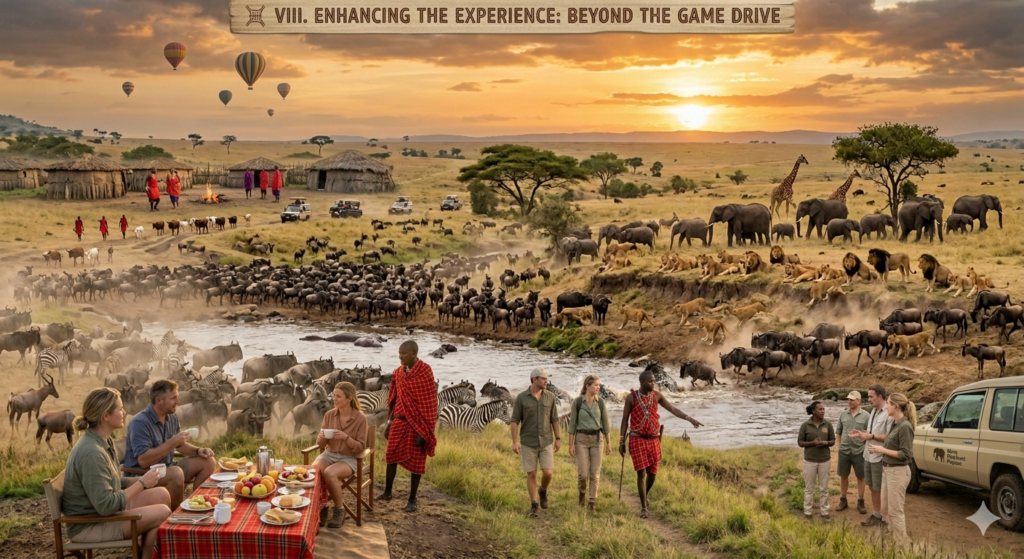
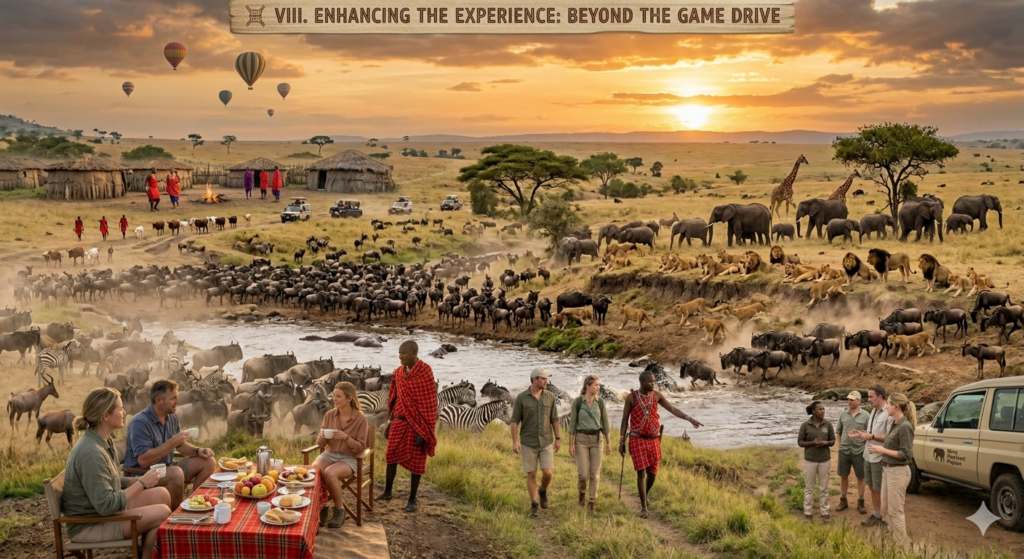
While the 4×4 game drive through the stunning landscape of the Mara in search of all the Big Five is core to any safari, there are many more ways to experience the full spectrum of the Mara’s ecosystems than many would realise. We can help you maximise your time here by ensuring that you make the most of more than just game driving.
Hot Air Balloon Safaris: A Bird’s-Eye View
There is little that can rival the tranquility of being suspended silently in the air, at dawn, over the African savannah. A hot air balloon safari offers a fresh perspective on Nature’s most dramatic setting.
Gently floating above the Mara River and vast savannah plains, casting large shadows across grazing herds of zebras and elephant, as the sun rises to a new day, makes for an unforgettable safari experience.
Hot air balloon rides over the Northern Territory generally take off at dawn, and flights are about an hour long. But it’s the aftermath that’s truly memorable: you land in the bush and sit down for a champagne breakfast. Very picturesque. Prices start at $450 per person and top out at $550 per person. It’s premium travel, but worth it for the sheer magic of it all.
Cultural Maasai Village Visits
More than the incredible diversity of its wildlife, many consider a visit to the Mara to be incomplete without visiting a traditional Masai boma (village) and learning about the lives of its colourful people. Having lived in harmony with Kenya’s most dangerous predators for generations, the Masai lead a unique lifestyle that offers guests a singular cultural experience.
Visitors to a boma can expect a warm Masai welcome, which includes songs and dances, including the famous adumu (jumping) dance performed by the warrior class.You can even go inside their manyattas (mud and stick abodes) and learn how to make fire and purchase local beaded wares directly from the ladies themselves.
Recommended Approach: Choose to participate in cultural visits that are organized by good camps and tour operators. The entrance fee to these villages ($20-$30 per person) gets used as intended to support schools, clinics, and clean water projects and NOT wasted on some middleman in a tourist trap.
The Magic of Private Conservancies
While the main Masai Mara National Reserve is unparalleled, it operates under strict regulations: no driving off-road, no walking safaris, and strict adherence to the 6:00 PM park closure. If you want a more exclusive, flexible adventure, consider staying in one of the private conservancies bordering the main reserve, such as Mara North, Naboisho, or Olare Motorogi.
Capacity is managed in designated areas to ensure appropriate levels of habitat space and to prevent overcrowding, allowing for great animal viewing encounters.
On private Maasai owned lands the rules are slightly different, in Conservancy areas guides are able to drive across the country to get closest views of animals such as perched tree lions. On nights when conditions allow, guests can enjoy a spotlit night game drive in search of nocturnal predators, such as aardvarks, bats, owls and hunting lions.
Visitors can also participate in guided Masai Mara safari guide 2026 with expert professional guides and trackers. Using their intimate knowledge of the surroundings and guiding guests on foot allows for unique interactions in some of the most spectacular and unfenced areas of the world..
Our base is in a wonderful camp, with stunning views of the plains, and by staying here you are directly supporting a vital conservation model that pays Maasai landowners an income to conserve their land and habitat, rather than bringing it into production as farmland.
IX. Conclusion
A Masai Mara safari is probably the most profound travel experience on the planet. In addition to navigating the 2026 park regulations and factoring the costs of travelling to relatively remote regions, you have to work out a budget for accommodation and factor in the costs of a month-long sojourn to Africa’s favourite safari destination.
But nothing beats the rewards. Watching millions of wildebeest migrate across the lush green plains or sharing an intimate gaze with a lazy lioness catching a snooze in the branches of a giant acacia tree, is pure magic. YCS lies at the end of a long dirt road, far from modern distractions and noise. However, at the end of this road is a place where you can feel Nature’s own heartbeat, powerfully immediate.
Due to the massive popularity of the Mara, especially during the peak season of the Great Migration it is essential to book early. It is not uncommon for the entire Mara to get booked solid a year in advance. As a result, we recommend planning ahead and booking your lodges and flights at least 9 to 12 months in advance.
Please travel with a responsible and eco-aware tour operator of choice. We will address the new 12 hour park fee regulation and our preferred safari operator will assist in gaining the very best experiences within the private conservation areas. The African Savannah awaits! Start planning your dream safari today!